


TL;DR:
- A trust avoids probate by holding legal title to assets, allowing direct transfer to beneficiaries without court involvement. Proper funding through retitling assets is essential to ensure the trust’s effectiveness in Rhode Island.
A revocable living trust avoids probate because it holds legal title to your assets, meaning those assets never become part of your personal estate at death. When you pass away, your trustee transfers property directly to your beneficiaries without any court involvement. For Rhode Island families, that distinction matters enormously. The Rhode Island Probate Court process can be slow, public, and costly. Understanding why trust avoids probate explained in plain terms is the first step toward protecting what you have built.
How does a trust avoid probate in Rhode Island?
A trust bypasses probate through a simple legal principle: the trust owns the assets, not you personally. When you die, your personal estate goes through the Rhode Island Probate Court. Assets titled in the name of your trust do not. They pass directly to your named beneficiaries under the trust’s terms.
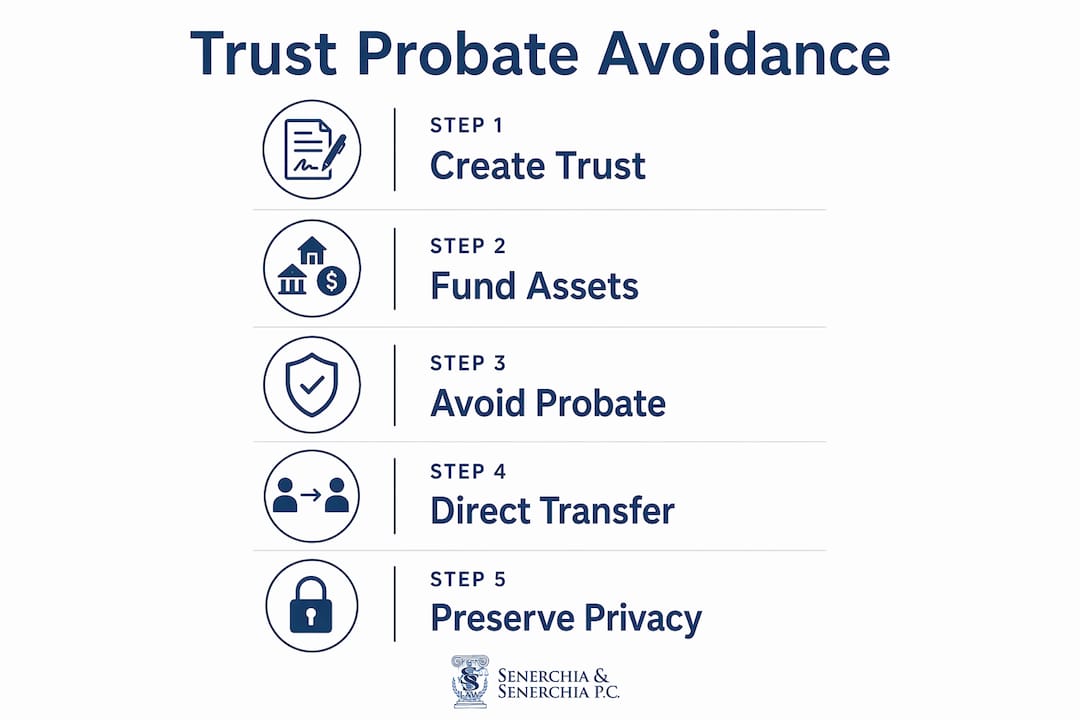
Here is how the mechanism works in practice:
- Create the trust document. You establish a revocable living trust and name yourself as the initial trustee, keeping full control during your lifetime.
- Fund the trust. You retitle your assets into the trust’s name. Your home, bank accounts, and investment accounts must be transferred to “The [Your Name] Revocable Living Trust” to be protected.
- Name a successor trustee. This person steps in immediately upon your death or incapacity, with no court appointment required.
- Distribute assets. Your successor trustee follows the trust’s instructions and transfers assets directly to beneficiaries, often within weeks rather than months.
One often overlooked benefit applies directly to New England families who own property in multiple states. Ancillary probate arises when real estate in multiple states requires separate probate proceedings. Placing out-of-state property inside your trust eliminates that second court process entirely.
Pro Tip: Funding your trust is not a one-time task. Every new asset you acquire should be titled in the trust’s name immediately, or it may end up in probate anyway.

What are the benefits of using a trust to avoid probate?
The advantages of probate avoidance go well beyond saving time. For Rhode Island families, three benefits stand out most clearly.
- Privacy. Assets held in a trust remain private, unlike wills, which become public record upon probate. Anyone can walk into a Rhode Island Probate Court and read your will after it is filed. A trust keeps your beneficiaries, asset values, and family arrangements entirely confidential.
- Cost savings. Probate can cost up to 7% of an estate’s value. On a $500,000 estate, that is $35,000 in court fees, executor compensation, attorney fees, and appraiser costs before your heirs receive a dollar.
- Incapacity planning. A successor trustee can manage trust assets immediately if you become incapacitated, avoiding court-appointed guardianship delays. This is a significant advantage over a will, which only takes effect at death.
“A revocable trust provides a safety net that allows grantors to control assets and name successor trustees without the court delays experienced by executors. For families with complex assets or properties in multiple New England states, that continuity is irreplaceable.”
Families with vacation homes in Connecticut or Massachusetts alongside a Rhode Island primary residence benefit especially from trust planning. Placing all properties in one trust eliminates the need for separate probate proceedings in each state. That alone can save thousands of dollars and months of delay.
What are common reasons trusts fail to avoid probate?
The most common reason a trust fails to avoid probate is simple: the assets were never transferred into it. Without proper funding, a trust document is just paper. The Rhode Island Probate Court will still process any asset that remains titled in your personal name.
| Mistake | Consequence | Prevention |
|---|---|---|
| Forgetting to retitle the home | Real estate goes through probate | Deed the property into the trust at signing |
| Leaving bank accounts in personal name | Accounts subject to court process | Update account titles with your bank |
| Acquiring new assets after trust creation | New assets bypass the trust | Review and retitle new assets immediately |
| Relying solely on a pour-over will | Assets still pass through probate first | Fund the trust fully during your lifetime |
Many families assume a pour-over will solves the funding problem. It does not. Pour-over wills do not avoid probate. They catch assets left outside the trust and direct them into it, but those assets must still pass through probate administration first. That means delays and costs for your heirs, even with a pour-over will in place.
Rhode Island has specific procedural requirements for transferring real property into a trust, including proper deed preparation and recording with the local town or city clerk. Skipping that step is one of the most common estate planning mistakes families make in this state.
Pro Tip: Schedule an annual trust review with your attorney. Life changes like buying property, opening new accounts, or remarrying can leave assets outside your trust without you realizing it.
How to choose the right type of trust for probate avoidance in Rhode Island
Not every trust serves the same purpose. Choosing the right structure depends on your family’s goals, asset types, and long-term needs.
- Revocable living trusts are the most common choice for probate avoidance. You retain full control, can amend or revoke the trust at any time, and the assets transfer seamlessly at death. This is the right starting point for most Rhode Island families.
- Irrevocable trusts offer stronger asset protection but require you to give up control of the assets permanently. They are better suited for Medicaid planning or shielding assets from creditors, not simply for probate avoidance.
- Simpler alternatives exist for straightforward situations. Payable-on-death designations on bank accounts, transfer-on-death deeds for real property, and joint ownership with right of survivorship all bypass probate without a trust. These work well for smaller estates with uncomplicated family dynamics.
One important limitation applies to revocable trusts specifically. Revocable living trusts offer flexibility and control, but do not protect assets from creditors or Medicaid eligibility rules. If asset protection is a priority alongside probate avoidance, an irrevocable trust or other planning tools may be necessary. Senerchia & Senerchia Law helps Rhode Island families compare trust options to find the right fit for their specific situation.
The right trust type also depends on whether your estate involves business interests, rental properties, or blended family arrangements. Those complexities call for professional guidance tailored to Rhode Island law, not a generic online template.
Key Takeaways
A trust avoids probate because it holds legal title to assets, allowing them to pass directly to beneficiaries without Rhode Island Probate Court involvement, provided the trust is properly funded.
| Point | Details |
|---|---|
| Trusts hold legal title | Assets titled in the trust’s name bypass probate entirely at death. |
| Funding is non-negotiable | Retitling every asset into the trust is the only way to guarantee probate avoidance. |
| Pour-over wills still trigger probate | Assets caught by a pour-over will must pass through probate before reaching the trust. |
| Privacy and cost savings are real | Probate can cost up to 7% of estate value; trusts keep all details private. |
| Trust type must match your goals | Revocable trusts suit most families; irrevocable trusts serve asset protection needs. |
What I have learned from Rhode Island estate planning cases
After working with Rhode Island families across a wide range of estate situations, one pattern stands out clearly. Most people focus on creating the trust document and then stop there. The funding step gets treated as an afterthought, and that is where plans fall apart.
I have seen well-drafted trusts rendered useless because a family home was never deeded into the trust’s name. The family still faced Rhode Island Probate Court, still paid the fees, and still waited months for resolution. The trust document sat in a drawer doing nothing.
Probate avoidance is a real and worthwhile goal, but it is not the only reason to create a trust. Incapacity planning, privacy, and multi-state property management are equally compelling reasons for New England families. A trust is not a one-size-fits-all solution, and it is not always the right answer for every estate. For a smaller, straightforward estate, beneficiary designations and joint ownership may accomplish the same result at lower cost. The goal is a plan that fits your actual life, not a plan that looks good on paper. Rhode Island families deserve guidance that accounts for local probate procedures, state-specific deed requirements, and their own family dynamics. That kind of planning takes more than a template.
— Anthony
Estate planning support for Rhode Island families
Senerchia & Senerchia Law works with individuals and families throughout Rhode Island and Southern New England to create trusts that actually function as intended. That means drafting the document, guiding you through the funding process, and helping you maintain the trust as your life changes. The firm’s attorneys understand Rhode Island’s probate procedures and the specific steps required to transfer real property, financial accounts, and other assets into a trust correctly. If you are ready to protect your family from unnecessary court delays and costs, the estate planning attorneys at Senerchia & Senerchia Law can help you build a plan that works. You can also review the estate planning documents families typically need to get started.
FAQ
What makes a trust avoid probate?
A trust avoids probate because it holds legal title to assets in its own name, so those assets do not pass through your personal estate at death. The trustee transfers them directly to beneficiaries without court involvement.
Does a pour-over will avoid probate in Rhode Island?
No. A pour-over will directs assets into your trust after death, but those assets must still pass through Rhode Island probate administration first, causing delays and costs for your heirs.
What happens if I never fund my trust?
An unfunded trust does not avoid probate. Any asset that remains titled in your personal name at death will go through the Rhode Island Probate Court, regardless of what your trust document says.
Can a revocable trust protect my assets from creditors?
No. Revocable trust assets remain reachable by creditors during your lifetime because you retain control. An irrevocable trust is the appropriate tool for creditor protection.
Do I need a trust if I only own property in Rhode Island?
Not necessarily. For simpler estates, payable-on-death designations and beneficiary designations may be sufficient. A trust becomes more valuable when you own real estate in multiple states, have complex family arrangements, or want to plan for incapacity.