


TL;DR:
- Asset protection involves structuring your finances early to make creditor claims more difficult to pursue.
- Timing is critical because transfers made before legal threats are treated as legitimate, whereas late transfers are often reversed.
Asset protection is defined as the legal practice of structuring your finances so that creditors, plaintiffs, and courts find it significantly harder to seize what you own. The core principle behind why asset protection before a lawsuit matters is simple: the law rewards those who plan early and penalizes those who scramble late. Once a lawsuit is filed or even threatened, most of your options disappear. Transfers made at that point are presumed suspicious, and courts have broad authority to reverse them. The families and individuals who sleep soundly at night are the ones who built their defenses long before any legal storm appeared on the horizon.
Why asset protection before a lawsuit matters most
The legal term for what you are trying to avoid is a fraudulent transfer, also called a voidable transaction. This is what happens when a court decides you moved assets specifically to dodge a creditor, and then unwinds the transfer as if it never happened. Longer-established plans gain stronger legal protection precisely because they differentiate valid planning from last-minute concealment. The distinction between those two things is not just philosophical. It is the difference between keeping your home and losing it.
Timing is the single most important variable in asset protection before litigation. A plan built years before any claim arises carries far more legal weight than one assembled the week a lawsuit is filed. Courts, creditors, and bankruptcy trustees all look at the timeline of your financial decisions. Planning ahead is not just smart. It is legally necessary.

How fraudulent transfer laws impact asset protection timing
Fraudulent transfer law is the mechanism creditors use to undo asset moves they consider suspicious. Under the Uniform Voidable Transactions Act (UVTA), which most states have adopted, actual-intent claims have a 4-year lookback period, or one year from discovery. Federal bankruptcy law under 11 U.S.C. § 548 gives bankruptcy trustees a 2-year lookback to challenge transfers. That means a transfer you made two or three years ago could still be reversed if a court finds it was designed to hinder creditors.
Courts do not require a confession to find fraudulent intent. Instead, they rely on what are called “badges of fraud,” which are circumstantial factors that suggest improper motive. Common badges include:
- Transferring assets to a family member or close insider
- Retaining control over the transferred asset after the transfer
- Concealing the transaction or failing to disclose it
- Being insolvent at the time of the transfer, or becoming insolvent because of it
- Transferring assets shortly before incurring debt or facing a lawsuit
The law also distinguishes between actual fraud and constructive fraud. Actual fraud requires proof of intent to deceive. Constructive fraud does not. If you transferred an asset without receiving reasonably equivalent value in return, and you were insolvent at the time, a court can void the transaction even if you had no bad intent at all. Transferring your house to a family member for one dollar shortly before filing bankruptcy is the textbook example of both types at once.
Pro Tip: Document the fair market value of any asset you transfer and keep a written record of what you received in return. A solvency opinion from a qualified financial professional can strengthen your defense considerably if a transfer is ever challenged.
The role of exemptions and insurance in pre-claim asset protection
State and federal exemptions are automatic legal protections that limit what creditors can seize, and most people underestimate how powerful they are when used correctly. Exemptions apply both inside and outside bankruptcy proceedings, though the specific amounts and categories vary significantly by state. Rhode Island, like most states, provides exemptions for homestead equity, retirement accounts, personal property, and certain insurance proceeds.
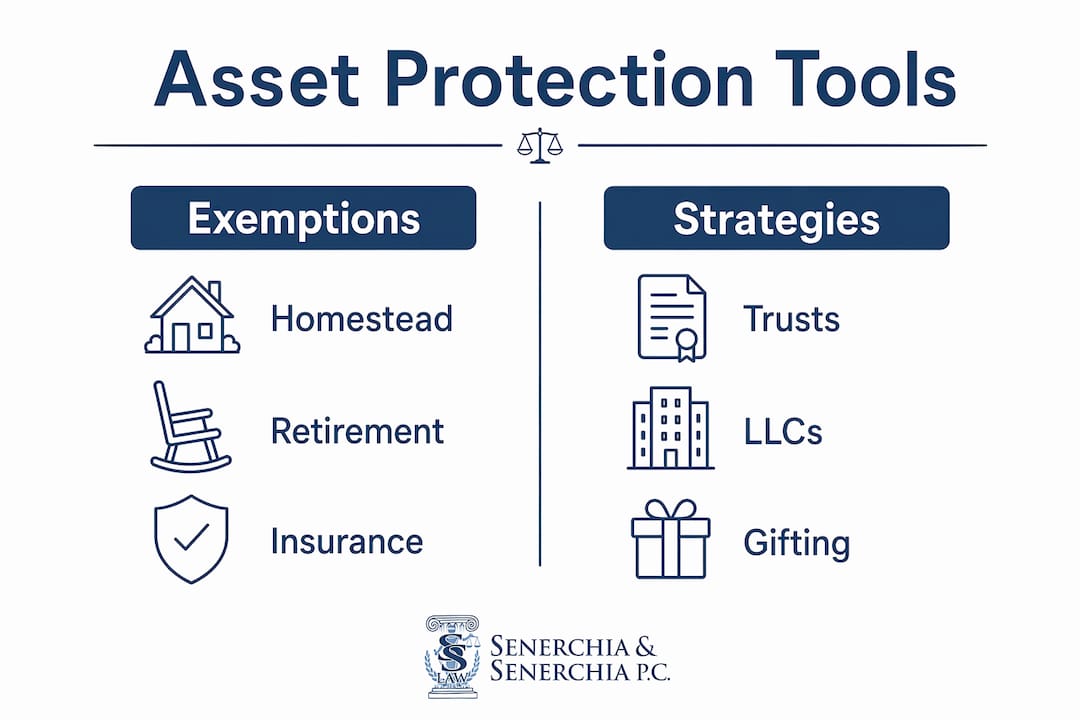
The key is positioning your assets to fall within protected categories before any claim arises. You cannot move money into a protected retirement account after a lawsuit is filed and expect the exemption to hold. But if your retirement savings have been growing in a qualified plan for years, that protection is solid.
Here is a quick comparison of common exemption types and how they function:
| Exemption type | What it protects | Applies in bankruptcy? |
|---|---|---|
| Homestead exemption | Equity in your primary residence up to a state limit | Yes |
| Retirement accounts | IRAs, 401(k)s, and similar qualified plans | Yes, often fully |
| Personal property | Clothing, household goods, vehicles up to a value cap | Yes |
| Life insurance cash value | Proceeds or cash value depending on state law | Varies by state |
| Annuities | Certain annuity contracts depending on state | Varies by state |
Beyond exemptions, umbrella liability insurance is often the first and most cost-effective line of defense against liability claims. A personal umbrella policy typically provides $1 million or more in coverage above your standard auto and homeowners limits. For most families, a well-structured insurance program means a creditor never needs to reach your actual assets at all. Think of insurance as the outer wall and your legal structures as the inner fortress.
Common asset protection strategies implemented before litigation
The most widely used legal tools for protecting assets before litigation are irrevocable trusts, limited liability companies (LLCs), and family limited partnerships (FLPs). Each works differently, and each has specific strengths depending on your situation.
-
Irrevocable trusts remove assets from your personal ownership entirely. Because you no longer legally own what is inside the trust, creditors generally cannot reach it. The catch is that you also give up control. An irrevocable trust established years before any claim is far more defensible than one created after a lawsuit is threatened.
-
LLCs and limited partnerships separate ownership risk by placing assets inside a legal entity. If someone sues you personally, they typically cannot reach assets held inside a properly structured LLC. However, establishing LLCs to hold assets must be paired with legitimate business purposes and proper formalities. Courts will pierce the corporate veil if an LLC is nothing more than a shell with no real operations, no separate bank account, and no documentation.
-
Family limited partnerships allow you to transfer ownership interests to family members while retaining management control. They also offer valuation discounts for estate planning purposes, making them useful for both asset protection and wealth transfer goals.
-
Domestic asset protection trusts (DAPTs) are available in a growing number of states and allow the grantor to remain a discretionary beneficiary while still shielding assets from future creditors. Rhode Island does not currently have a DAPT statute, but residents can use trusts in states that do.
Pro Tip: The longer a structure has been in place before a claim arises, the harder it is for a creditor to challenge. Set up your entities and trusts now, not when you hear footsteps.
An asset protection blueprint typically layers these tools together rather than relying on any single strategy. A trust might hold real estate while an LLC holds a business interest, and umbrella insurance covers day-to-day liability exposure. The combination is what creates real resilience.
Why timing deters lawsuits and encourages favorable settlements
Early asset protection does more than just defend you legally. It changes the math for anyone considering a lawsuit against you.
“Asset protection functions like a wall that makes pursuing claims more difficult, often incentivizing favorable settlements or discouraging lawsuits entirely.” — Fidato Wealth
When a plaintiff’s attorney evaluates whether to take a case on contingency, the first question is: what can we actually collect if we win? If your assets are held inside well-structured trusts and entities, the answer becomes complicated and expensive to pursue. Litigation is costly. Attorneys who work on contingency need a realistic path to recovery. A credible, established asset protection plan raises the cost and lowers the expected reward for the opposing side.
This dynamic plays out in settlement negotiations as well. When a plaintiff knows that even a favorable judgment will be difficult to collect, they are far more willing to accept a reduced settlement. You gain leverage not by hiding assets, but by legally restructuring ownership so that collection becomes genuinely difficult. That is a meaningful, practical benefit that goes beyond simply “protecting” what you have.
Practical steps to take now for pre-lawsuit asset protection
The most common mistake families make is waiting until a threat appears before calling an attorney. By then, every move you make is scrutinized. Here is how to approach pre-litigation planning the right way:
-
Start before any threat exists. The best time to build your protection is when everything is calm. Courts and creditors have no basis to challenge transfers made years before any claim arises, provided they were done for legitimate reasons and with proper documentation.
-
Consult a qualified estate planning and asset protection attorney. Asset protection intersects with estate planning, tax law, and business law. An attorney who handles all three can build a plan that works across all dimensions. The integration of estate and asset protection planning is where most families find the greatest long-term value.
-
Document solvency and value exchange for every transfer. If you move an asset into a trust or LLC, record what you received in return and confirm in writing that you remained solvent after the transfer. This documentation is your defense if the transfer is ever challenged.
-
Avoid last-minute transfers. A transfer made after you receive a demand letter, after a lawsuit is filed, or even after you reasonably anticipate a claim is almost certainly challengeable. Last-minute transfers intended to evade creditors are frequently unwound under both state and federal law.
-
Review your insurance coverage annually. Umbrella policies, professional liability coverage, and business insurance should be reviewed every year to confirm limits are adequate. Insurance gaps are often where creditors find their opening.
-
Revisit your plan after major life changes. Marriage, divorce, a new business, an inheritance, or a real estate purchase all change your exposure profile. Your protection plan should evolve with your life. Early planning that was right at 40 may need adjustment at 55.
The families who protect their assets early are not the ones who expected trouble. They are the ones who understood that legal exposure is a fact of modern life and chose to address it while they still had full options available.
Key takeaways
Pre-litigation asset protection is the only kind that works. Transfers made after a lawsuit arises are presumed fraudulent and can be reversed, which means every effective strategy must be built before any legal threat appears.
| Point | Details |
|---|---|
| Timing is everything | Asset protection plans established years before a claim are legally stronger and harder to challenge. |
| Fraudulent transfer laws have long reach | Courts can unwind transfers made up to 4 years before a claim under the UVTA, and 2 years under federal bankruptcy law. |
| Exemptions require proactive positioning | Retirement accounts, homestead equity, and other exempt assets must be in place before a claim arises to receive full protection. |
| Structures need legitimate purpose | LLCs and trusts must have real business or estate planning purposes, or courts will disregard them entirely. |
| Early planning changes settlement math | Creditors and plaintiffs are less likely to pursue or escalate claims when collection is legally complex and expensive. |
Protect your assets with experienced legal guidance
At Senerchia & Senerchia Law, we work with individuals and families throughout Rhode Island and Southern New England to build asset protection plans that hold up when it matters most. Waiting until a lawsuit is filed is not a strategy. It is a risk. Our attorneys help you evaluate your current exposure, identify the right combination of trusts, entities, exemptions, and insurance, and put a plan in place while you still have every option available. Whether you are a homeowner, a business owner, or a family with significant assets to protect, we provide clear, practical guidance tailored to your specific situation. To learn more about how we can help, visit our asset protection planning page or contact us to schedule a consultation.
FAQ
Why does asset protection need to happen before a lawsuit?
Once a lawsuit is filed or anticipated, any asset transfer you make is subject to fraudulent transfer laws that allow courts to reverse it. Protection built before any legal threat arises is far harder for creditors to challenge.
What is the lookback period for fraudulent transfers?
Under the Uniform Voidable Transactions Act, creditors can challenge transfers made up to 4 years before a claim, or within 1 year of discovery. Federal bankruptcy law gives trustees a 2-year lookback under 11 U.S.C. § 548.
Can an LLC really protect my personal assets?
An LLC can separate your personal assets from business liabilities, but only if it is properly maintained with separate accounts, documented formalities, and a legitimate business purpose. Courts pierce the corporate veil when an LLC is treated as an extension of personal finances.
Are retirement accounts protected from creditors?
Qualified retirement accounts like 401(k)s and IRAs receive strong protection under both federal and state exemption laws, both inside and outside bankruptcy. The protection applies when those accounts are in place before any claim arises, not after.
What is the first step in building an asset protection plan?
The first step is consulting a qualified estate planning and asset protection attorney before any legal threat exists. An attorney can assess your current exposure, identify gaps in your insurance and ownership structure, and recommend the right combination of legal tools for your situation.