


TL;DR:
- Losing a parent in Rhode Island requires following strict legal procedures, including timely death reporting and probate. Executors must obtain court approval before acting on estate assets, especially in local municipal courts for each family. Proper attorney guidance helps families meet deadlines, manage responsibilities, and avoid liability during estate settlement.
Losing a parent is one of the hardest experiences a family faces. Knowing what to do legally when a parent dies in Rhode Island helps you protect your family’s interests and meet the state’s specific legal requirements. Rhode Island law sets firm deadlines, requires licensed professionals for body care, and routes most estates through a municipal probate court system that differs from most other states. This guide walks you through each required step, from the first 48 hours through final estate distribution, so you can move forward with clarity and confidence.
What are the first legal steps after a parent’s death in Rhode Island?
The first legal obligation after a parent dies in Rhode Island is reporting the death to the local registrar within 48 hours. That deadline is not a suggestion. It is a statutory requirement, and the attending physician must complete the medical portion of the death certificate within the same window.
Rhode Island law also requires that a licensed funeral director or crematory operator handle all removal, preparation, and disposition of the body. You cannot transport or prepare the body yourself. This rule applies regardless of your family’s wishes or circumstances.
Here are the concrete steps to take immediately:
- Contact a licensed funeral director. They manage body removal, preparation, and filing of the death report with the local registrar.
- Obtain certified copies of the death certificate. The Rhode Island Department of Health, Division of Vital Records, issues these. Order at least 8 to 10 certified copies. Banks, courts, insurers, and government agencies each require an original.
- Locate the will and any estate planning documents. Check safe deposit boxes, home files, and your parent’s attorney’s office.
- Notify Social Security, pension providers, and financial institutions. Each has its own notification process and timeline.
- Secure the property. Change locks if the home is vacant and notify the homeowner’s insurance carrier.
Pro Tip: Ask the funeral director to order certified death certificates on your behalf at the time of filing. Ordering them later through the Rhode Island Department of Health takes longer and costs more per copy.
How does probate work in Rhode Island when a parent dies?
Rhode Island probate is handled at the municipal level, not the state level. That means you file in the probate court of the city or town where your parent lived, not in a central state court. Each municipality runs its own process, which is why local court knowledge matters so much here.

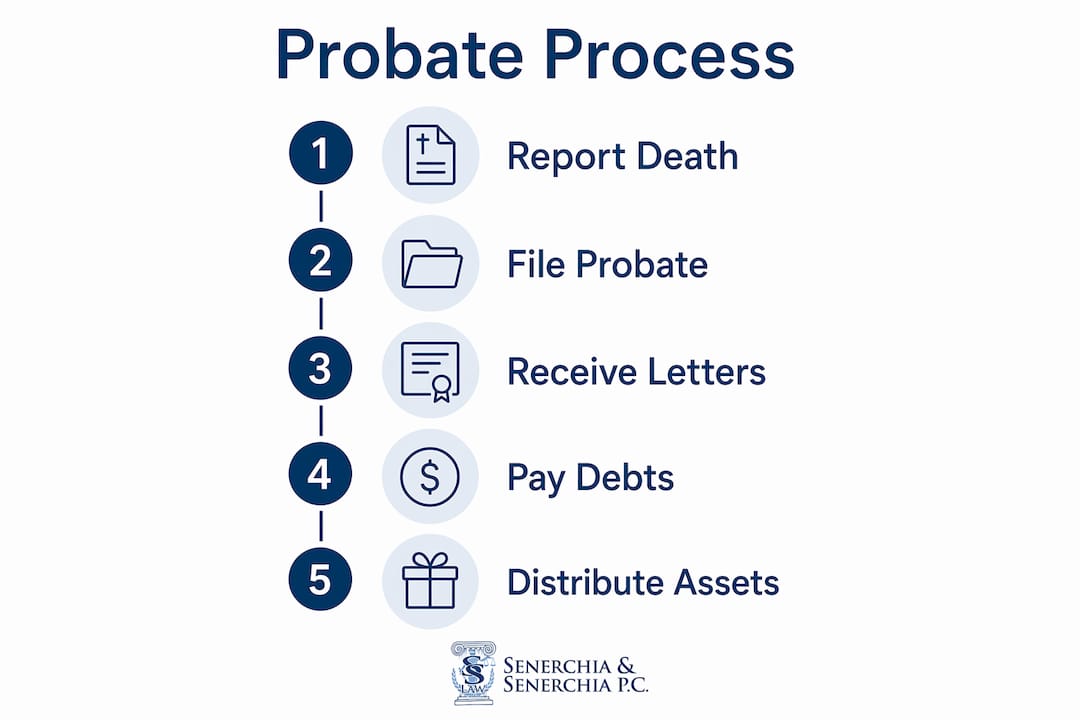
If your parent left a will, the named executor files a Petition for Probate of Will using Form PC-1.5 in the appropriate municipal probate court. The court schedules a hearing, reviews the will, and issues Letters Testamentary to the executor if everything is in order. Those letters are the executor’s legal authority to act on behalf of the estate.
Key steps in the Rhode Island probate process include:
- File Form PC-1.5 with the municipal probate court in your parent’s city or town.
- Attend the probate hearing where the court formally admits the will and appoints the executor.
- Receive Letters Testamentary from the court before taking any action on estate assets.
- Notify all beneficiaries and heirs as required by Rhode Island law.
- Publish notice to creditors and allow the statutory claim window to pass before distributing assets.
One detail families frequently miss: executor authority is not immediate. You cannot sign as a bank account holder, transfer property, or access investment accounts until the court issues Letters Testamentary. Acting before that point can create personal liability. Probate also takes longer than most families expect because creditors have a defined claim window that extends the timeline even in straightforward cases.
Pro Tip: Keep a dedicated folder for every court filing, notice, and correspondence related to the estate. Rhode Island probate courts require a final accounting, and organized records make that process far less stressful. For a full breakdown of the process, the Rhode Island probate guide from Senerchia & Senerchia Law covers current 2026 procedures in detail.
What happens if a parent dies without a will in Rhode Island?
When a parent dies without a will, the legal term for that situation is dying “intestate.” Rhode Island’s intestate succession laws, found in Title 33 of the General Laws, determine who inherits and in what order. The court appoints an administrator, rather than an executor, to manage the estate. That administrator has the same duties as an executor but is chosen by the court rather than named in a will.
Rhode Island’s intestate succession rules follow a clear hierarchy. A surviving spouse does not automatically receive everything outright. If children also survive, the spouse may receive a life estate in real property rather than full ownership. Children inherit according to how many are living. If no spouse or children survive, the estate passes to parents, then siblings, and so on down the statutory line.
The table below shows how Rhode Island distributes assets under intestate succession:
| Surviving relatives | Who inherits |
|---|---|
| Spouse and children | Spouse receives life estate in real property; children inherit the remainder |
| Spouse only (no children) | Spouse inherits the entire estate |
| Children only (no spouse) | Children divide the estate equally |
| No spouse or children | Parents, then siblings, then more distant relatives |
| No surviving relatives | Estate passes to the State of Rhode Island |
Dying without a will creates real complications for families. The life estate distinction is a good example. A surviving parent who receives only a life estate in the family home cannot sell or mortgage the property without the consent of the children who hold the remainder interest. That kind of legal constraint can create conflict and delay. For a deeper look at how this plays out, Senerchia & Senerchia Law’s guide on dying without a will in Rhode Island explains the practical consequences in plain terms.
What are the key executor responsibilities in Rhode Island?
An executor, formally called a personal representative in Rhode Island, carries significant legal duties throughout the estate administration process. Those duties begin the moment Letters Testamentary are issued and do not end until the court formally discharges the executor. Understanding executor responsibilities in Rhode Island upfront prevents costly mistakes.
The core duties follow a logical sequence:
- Inventory all estate assets. This includes bank accounts, real estate, vehicles, investments, personal property, and any business interests. Rhode Island probate courts require a formal inventory to be filed.
- Obtain appraisals where needed. Real estate and valuable personal property must be professionally appraised to establish fair market value at the date of death.
- Pay debts in the correct legal order. Rhode Island law sets a priority sequence. Funeral expenses are paid first, before any other bills or distributions. Administration costs come next, followed by taxes and then general creditors.
- File the estate’s tax returns. This includes any final personal income tax return for your parent and, if the estate generates income during administration, a fiduciary income tax return.
- Communicate regularly with beneficiaries. Executors have a fiduciary duty to keep beneficiaries informed. Silence creates suspicion and sometimes litigation.
- File a final accounting with the probate court. This document shows every dollar that came into the estate and every dollar that went out. The court reviews it before approving final distributions.
- Distribute assets to beneficiaries according to the will or intestate succession rules after court approval.
- Petition for discharge. Once distributions are complete and the court approves the final accounting, the executor files for formal discharge, which ends personal liability for estate matters.
Executors who skip steps or act out of order face personal liability. Rhode Island courts take fiduciary duty seriously. If you are named as executor and feel uncertain about any part of the process, working with a probate attorney from the start is the most practical protection you can give yourself.
Key Takeaways
Settling a parent’s estate in Rhode Island requires meeting firm legal deadlines, filing in the correct municipal probate court, and following a defined sequence of executor duties from inventory through final court discharge.
| Point | Details |
|---|---|
| Report the death within 48 hours | Rhode Island law requires death reporting to the local registrar within 48 hours of death. |
| Use a licensed funeral director | State law prohibits personal handling of the body; a licensed professional is legally required. |
| File probate in the right municipality | Rhode Island probate is handled locally, so you file in the city or town where your parent lived. |
| Executor authority requires court approval | You cannot transfer assets or act on accounts until Letters Testamentary are issued by the court. |
| Funeral expenses are paid first | Rhode Island law prioritizes funeral costs above all other estate debts and distributions. |
How Senerchia & Senerchia Law can help your family
Settling a parent’s estate while grieving is genuinely hard. The legal requirements in Rhode Island are specific, the timelines are strict, and a single misstep can delay distributions or create personal liability for the executor. Senerchia & Senerchia Law works with Rhode Island families through every stage of this process, from filing the initial probate petition to closing the estate and distributing assets. The firm’s attorneys handle probate and estate administration for families across Rhode Island and Southern New England, and they also help families avoid these complications entirely through proactive estate planning documents like wills, trusts, and powers of attorney. If you are currently managing a parent’s estate or want to protect your own family from this process in the future, Senerchia & Senerchia Law offers the clear, practical guidance you need.
FAQ
How soon must a death be reported in Rhode Island?
Rhode Island requires deaths to be reported within 48 hours to the local registrar. Licensed funeral directors typically handle this filing as part of their standard services.
Where do you file for probate in Rhode Island?
You file in the probate court of the municipality where your parent lived at the time of death. Rhode Island uses a municipal probate system, so each city and town runs its own court.
Can an executor act before receiving Letters Testamentary?
No. Executor authority begins only after the probate court issues Letters Testamentary. Acting before that point can create personal legal liability.
What is intestate succession in Rhode Island?
Intestate succession is the legal process that distributes a deceased person’s assets when they die without a will. Rhode Island follows Title 33 of the General Laws, which sets a statutory order starting with the spouse and children.
How long does probate take in Rhode Island?
Probate timelines vary, but the process commonly extends for several months because Rhode Island law gives creditors a defined window to file claims before the executor can make final distributions.