


The estate settlement process is the legally required sequence of steps to collect a deceased person’s assets, pay outstanding debts, file taxes, and distribute remaining property to heirs or beneficiaries under court supervision. Also called estate administration, this process typically involves a court-appointed executor or personal representative who carries fiduciary duties to act in the estate’s best interest at every stage. Here in Rhode Island and across Southern New England, the process has some important local distinctions worth knowing before you begin.
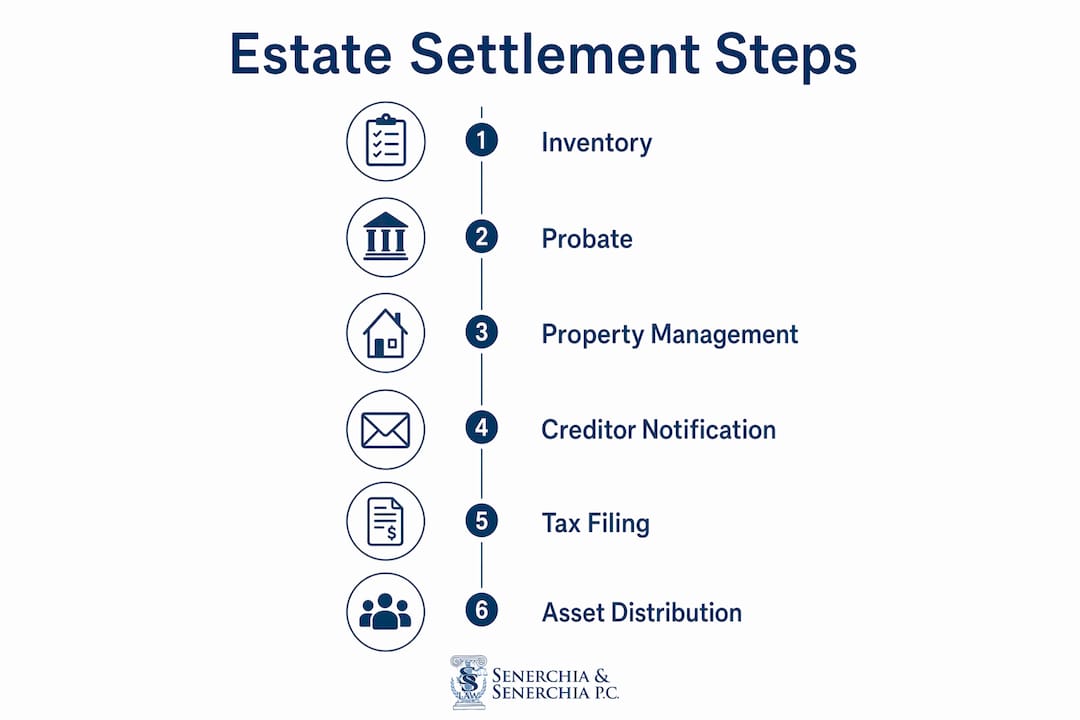
The major steps in the estate settlement process include:
- Inventorying all assets owned by the decedent
- Filing a petition for probate with the appropriate court
- Protecting and managing estate property during administration
- Notifying creditors and paying valid debts
- Filing the decedent’s final tax returns
- Distributing remaining assets to heirs or beneficiaries
- Closing the estate with a formal court decree
Rhode Island operates a municipal probate court system with a separate court for each city and town, meaning the procedures and timelines you encounter depend directly on where your loved one lived. That local variability makes working with an experienced Rhode Island probate attorney especially valuable. Senerchia & Senerchia Law has guided families through every stage of this process throughout the state and Southern New England.
What does the estate settlement process actually involve?
Estate settlement, formally known as estate administration, is the court-supervised process of wrapping up a person’s financial and legal affairs after death. The executor named in the will, or an administrator appointed by the court when there is no will, manages the entire process. Their job touches everything from locating a safe deposit box to signing over a deed.
Understanding the full scope upfront helps you avoid surprises. The sections below walk through each step in the order they typically occur.

Step 1: Creating a detailed inventory of the decedent’s assets
The first task for any executor is building a complete picture of what the estate owns. You cannot pay debts, file taxes, or distribute property accurately without knowing what exists and what it is worth.
Common asset categories to document include:
- Real estate: homes, rental properties, and land in Rhode Island or other states
- Financial accounts: checking, savings, investment, and retirement accounts
- Personal property: vehicles, jewelry, artwork, furniture, and collectibles
- Business interests: ownership stakes in partnerships or closely held companies
- Digital assets: online accounts, cryptocurrency, and intellectual property
- Life insurance policies with the estate named as beneficiary
- Outstanding debts owed to the decedent, such as promissory notes
Executors in Rhode Island must file a formal asset inventory, Form PC-1.5, with the municipal probate court. Real estate and other high-value items typically require a professional appraisal to establish fair market value at the date of death. Gathering original or certified copies of the death certificate early speeds up nearly every step that follows, since banks, title companies, and government agencies all require one.
Pro Tip: Request at least ten certified copies of the death certificate from the vital records office. You will need them for financial institutions, the probate court, the IRS, and property transfers, and ordering more later adds time and cost.

Step 2: Initiating probate and completing related legal procedures
Probate formally opens the estate and gives the executor legal authority to act. In Rhode Island, you file a petition for probate with the probate court in the city or town where the decedent lived at the time of death. Because Rhode Island has independent municipal probate courts, each with its own clerk and local procedures, the filing requirements can differ from one municipality to the next.
Key filings and formalities at the start of probate typically include:
- Filing the original will and death certificate with the probate court
- Paying the court filing fee, which in Rhode Island is generally a percentage of personal property value, with a minimum and maximum fee limits
- Petitioning for appointment as executor or administrator
- Receiving the Certificate of Appointment, which authorizes you to act on behalf of the estate
- Posting a surety bond if required
On the surety bond: Rhode Island law may require executors to post a bond equal to the estate’s personal property value unless the will specifically waives it. The bond protects beneficiaries against mismanagement. If the will is silent on the issue, check with your local probate clerk or an attorney before assuming a waiver applies.
Once the court issues your Certificate of Appointment, you have the legal standing to access accounts, manage property, and take the steps that follow. For a deeper look at how this works locally, the Rhode Island probate guide from Senerchia & Senerchia Law covers court-specific procedures in detail.
Step 3: Protecting and managing estate property during settlement
Between the date of death and final distribution, estate property can be damaged, stolen, or lose value if no one actively manages it. The executor is legally responsible for preventing that from happening.
Practical protective steps every executor should take:
- Change the locks on any real estate the estate owns
- Maintain or obtain homeowner’s and auto insurance policies in the estate’s name
- Keep all financial accounts open and funded to cover ongoing expenses like utilities and property taxes
- Secure and catalog personal property, especially jewelry, art, and collectibles
- Keep detailed records of every expense paid from estate funds
The legal standard is prudent management, meaning you act as a careful, reasonable person would with their own property. Executors who neglect these duties can face personal liability, and Rhode Island probate courts take that seriously. If the estate includes rental property, you may also need to manage tenants, collect rent, and make necessary repairs during the administration period.
Step 4: Notifying creditors and paying valid debts and claims
Creditors have legal rights to be paid from the estate before any assets go to heirs. Rhode Island law requires the executor to publish a notice to creditors in a newspaper of general circulation in the county where the decedent lived. That publication starts the clock on the mandatory creditor claim period lasting several months.
Executor tasks during the creditor notification and claims phase:
- Publish the notice to creditors as required by Rhode Island law
- Send direct written notice to known creditors
- Review each claim submitted and determine whether it is valid
- Accept valid claims and dispute those that appear improper or inflated
- Pay approved debts in the legally required priority order
The mandatory waiting period following creditor notice must be observed before final distribution of estate assets can occur, and all valid claims must be resolved. Debts are generally paid in a specific priority order: funeral and administration expenses come first, followed by taxes, then general creditor claims. If the estate lacks sufficient funds to pay everyone, lower-priority creditors may receive nothing, and heirs receive nothing until all valid debts are settled.
Step 5: Filing required tax returns and managing accounting
Tax obligations do not end at death. The executor must file the decedent’s final federal income tax return for the year of death, and a separate estate income tax return may be required if the estate generates income during administration. Rhode Island adds a state-level layer as well.
Common tax and accounting tasks during estate settlement:
- File the decedent’s final Form 1040 with the IRS for the year of death
- File a federal estate tax return (Form 706) if the estate exceeds the federal exemption threshold
- File Rhode Island Form RI-706 if the estate exceeds roughly $1.8 million, the state’s estate tax threshold
- Prepare a detailed accounting of all estate income, expenses, debt payments, and proposed distributions
- Submit the accounting to the probate court for approval before distribution
The accounting is more than a formality. It is the document that shows the court, and the beneficiaries, exactly where every dollar went. Errors or omissions can delay court approval and push back the distribution date. Rhode Island’s municipal probate courts each have their own standards for how accountings must be formatted and filed, so local knowledge matters here.
Step 6: Distributing remaining assets to heirs or beneficiaries
Once the creditor claim period has passed, all debts and taxes are paid, and the court approves the final accounting, the executor can distribute what remains. This is the step most families are waiting for, and it requires careful documentation to protect everyone involved.
Key distribution and closing tasks include:
- Obtaining court approval of the final accounting and proposed distribution plan
- Transferring real estate titles through probate deeds recorded with the city or town
- Closing or retitling financial accounts according to the will or intestacy law
- Delivering personal property to the appropriate beneficiaries
- Collecting signed receipts or releases from each beneficiary confirming they received their share
- Filing a petition to close the estate and obtaining the court’s final decree
If the decedent died without a will, the process of estate distribution follows Rhode Island’s intestacy statutes, which set out a fixed order of inheritance based on family relationships. Spouses, children, and then more distant relatives receive assets in a sequence defined by law, regardless of what the decedent may have verbally expressed. For families navigating real property transfers through probate, working with an attorney who knows local recording requirements prevents costly title defects down the road.
How long does estate settlement take, and what does it cost?
Most Rhode Island probate cases take many months from filing to final distribution, largely because the mandatory creditor claim period sets a hard floor on the timeline. Add in court scheduling, tax filings, and the time needed to sell or transfer property, and a year or more is a realistic expectation for most families.
Smaller estates have a faster path. Rhode Island allows voluntary, informal administration for smaller estates under a personal property value threshold, and those cases typically wrap up more quickly.
Typical Rhode Island probate costs at a glance: Court filing fees are based on personal property value, with established minimum and maximum amounts. Publication fees for the creditor notice vary and can be several hundred dollars. Additional costs include appraisal fees, accounting fees, and attorney fees, which vary by estate complexity.
Cost components to budget for include:
- Court filing fees based on personal property value
- Newspaper publication fees for the creditor notice ($150–$300)
- Professional appraisal fees for real estate and personal property
- Accounting and bookkeeping fees for the estate’s financial records
- Attorney fees, which may be hourly or a percentage of the estate
- Executor compensation, if claimed under Rhode Island law
One factor that catches families off guard is the variability across Rhode Island’s 39 municipal probate courts. Processing times, local filing requirements, and clerk responsiveness differ from Providence to Westerly to Woonsocket. An executor unfamiliar with the local court’s expectations can lose weeks to procedural back-and-forth that an experienced local attorney would avoid.
Executors who fail to meet their duties on time can face personal liability and potential removal by the probate court. That risk is one reason many families choose to work with a probate attorney from the start rather than after a problem arises.
What happens with unclaimed assets or missing heirs?
Unclaimed assets and missing heirs are more common than most families expect, and they create real legal obligations for the executor. You cannot simply distribute those shares to the remaining beneficiaries and close the estate.
When a beneficiary cannot be located after a reasonable search, the executor must make documented, good-faith efforts to find them. That typically means checking last known addresses, contacting relatives, and searching public records. If those efforts fail, the executor may petition the probate court for guidance on how to proceed.
Unclaimed assets that belong to a missing heir are generally held in trust or deposited with the state. Rhode Island, like every state, has an unclaimed property program administered by the Office of the General Treasurer, where funds can be held until the rightful owner or their heirs come forward. The estate cannot be fully closed until the court is satisfied that every beneficiary’s share has been properly accounted for, whether distributed, held in trust, or transferred to the state’s unclaimed property fund.
For estates that include business interests, the process of locating all stakeholders and resolving ownership questions can add considerable time. Families dealing with these complications benefit from working with attorneys who understand both probate law and business succession planning to untangle overlapping ownership issues efficiently.
If you are managing a loved one’s estate in Rhode Island or Southern New England and want experienced guidance through every step, Senerchia & Senerchia Law is here to help. From the first probate filing to the final court decree, our attorneys provide clear, practical support tailored to your family’s situation. Visit our probate and estate administration page to learn how we can help, or explore our estate planning services to protect your own family’s future.
Key Takeaways
The estate settlement process in Rhode Island typically takes 9–18 months for most estates, primarily due to the mandatory six-month creditor claim period. Small estates valued at $15,000 or less may qualify for voluntary, informal administration and usually close within 3–6 months.
Most Rhode Island estates take 9–18 months to settle, mainly due to the six-month mandatory creditor claim period. However, small estates valued at $15,000 or less are eligible for informal administration and usually close within 3–6 months.
Can an estate be settled without a lawyer?
Technically yes, but Rhode Island’s 39 municipal probate courts each have distinct local procedures, and executors who miss a filing requirement or deadline can face personal liability. An attorney familiar with the specific local court significantly reduces that risk.
Who gets paid first out of an estate?
Funeral and estate administration expenses are paid first, followed by taxes owed to federal and state authorities, and then general creditor claims. Heirs and beneficiaries receive distributions only after all valid debts and taxes are fully resolved.
How much does estate settlement cost?
Rhode Island court filing fees run roughly 1% of personal property value ($30 minimum, $1,500 maximum), plus publication fees of $150–$300. Additional costs include appraisals, accounting, and attorney fees, which vary based on the estate’s size and complexity.