


TL;DR:
- Updating your estate plan after a Rhode Island divorce requires revising wills, trusts, powers of attorney, healthcare directives, and beneficiary designations. Automatic revocation applies only to will provisions and does not update non-probate assets like IRAs or 401(k)s, which need individual updates. It is crucial to act within 60 days after final judgment to prevent unintended distribution to your ex-spouse.
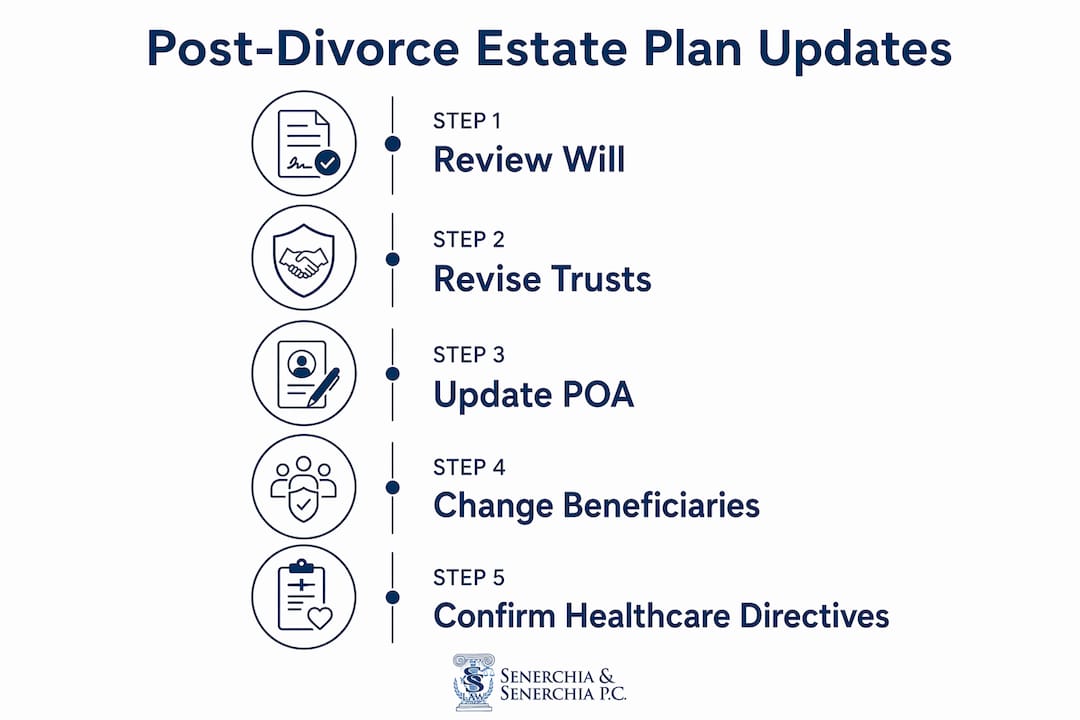
Updating your estate plan after a divorce in Rhode Island means revising your will, revocable trusts, powers of attorney, healthcare directives, and all beneficiary designations to reflect your new legal status. Rhode Island law automatically revokes will provisions that benefit a former spouse upon final divorce judgment under R.I. Gen. Laws § 33-5-9.1, but that protection does not extend to life insurance policies, IRAs, 401(k)s, or other non-probate assets. Those accounts require direct updates with each plan administrator. The state’s 90-day Nisi waiting period between the divorce decision and final judgment gives you a practical window to prepare every document so you can act immediately once the decree is final.
Which estate planning documents must you update after a Rhode Island divorce?
Five document categories require review and revision after every Rhode Island divorce: wills, revocable living trusts, powers of attorney, healthcare directives, and beneficiary designations. Skipping even one category can leave your former spouse with legal authority over your finances or your estate.
Your will
Rhode Island’s automatic revocation statute treats your ex-spouse as having predeceased you for purposes of any gift or fiduciary appointment named in your will. That sounds protective, but it creates gaps rather than solutions. The statute removes your ex-spouse’s name without replacing it, which means your estate may pass under intestacy rules to relatives you never intended to benefit. Rhode Island courts recommend executing a new will within 60 days of your final divorce judgment to give clear directions and name new fiduciaries. A new will in Rhode Island eliminates ambiguity entirely and reflects your actual wishes.
Revocable living trusts
A revocable living trust works like a container that holds your assets and controls how they pass to your beneficiaries. Divorce does not automatically amend that container. Updating a revocable trust after divorce typically requires a formal amendment or a full restatement of the trust to remove your ex-spouse as trustee or beneficiary. This is a separate legal step from updating your will, and it requires its own signed document. If you set up a living trust before your marriage, review every provision carefully.
Powers of attorney and healthcare directives
Automatic revocation may not apply to your durable power of attorney or your advance healthcare directive. That means your ex-spouse could retain legal authority to manage your finances or make medical decisions on your behalf unless you execute new documents naming a different agent. This is one of the most overlooked risks in post-divorce estate planning. Draft new documents immediately and deliver copies to your bank, your doctor, and any healthcare facility you use regularly.
Beneficiary designations
Life insurance policies, IRAs, 401(k)s, pensions, and transfer-on-death bank accounts all pass outside your will entirely. Beneficiary designations override your will regardless of what your will says or what Rhode Island’s revocation statute provides. If your ex-spouse is still listed as beneficiary on your life insurance policy, that policy pays out to your ex-spouse. Period. You must contact each plan administrator directly and submit updated beneficiary designation forms.
Pro Tip: Build a single folder, physical or digital, that contains every account statement, insurance policy, and legal document tied to your estate plan. Reviewing that folder in one sitting makes it far easier to spot accounts you might otherwise overlook.
When and how to update your estate plan during Rhode Island’s divorce timeline
Timing your updates correctly matters as much as making them. Rhode Island’s divorce process follows a specific sequence, and each stage has legal implications for your estate plan.
-
Filing and nominal hearing. Your divorce case begins with a filing and proceeds to a nominal hearing where the court reviews the terms. Your marriage remains legally intact at this stage, so any estate plan changes you make now are still made as a married person.
-
The 90-day Nisi waiting period. After the nominal hearing, Rhode Island law imposes a 90-day Nisi waiting period before the divorce becomes final. The divorce is decided but not yet legally complete. Use this window to prepare every document you will need. Compile your account list, draft your new will, amend your trust, and prepare new powers of attorney so they are ready to sign the moment the final decree issues.
-
Final judgment. The automatic revocation of will provisions under R.I. Gen. Laws § 33-5-9.1 triggers only upon final judgment. That is the moment your new estate planning documents should be executed.
-
Post-judgment execution. Sign your new will and trust documents as soon as possible after final judgment. Rhode Island courts recommend completing will execution within 60 days of that date. Submit beneficiary designation forms to each plan administrator within the same window.
-
Coordinate your attorneys. Your divorce attorney and your estate planning attorney need to communicate. Your divorce decree may include provisions about life insurance or retirement accounts that affect how you update beneficiary forms. Misalignment between the two can create legal complications.
Pro Tip: Estate planning attorneys call the document package you prepare during the Nisi period an “estate-plan divorce packet.” Compiling this packet before final judgment means you can execute everything within days of your decree, not weeks.
How do beneficiary designations affect your estate plan after divorce?
Beneficiary designations are the single most consequential piece of your post-divorce estate plan. They are also the piece most people neglect.
Rhode Island’s automatic revocation statute protects you on probate assets, meaning assets that pass through your will. It does not protect you on non-probate assets. Federal ERISA law actually preempts Rhode Island’s revocation statute for employer-sponsored retirement plans, including 401(k)s, 403(b)s, and pensions. That means your ex-spouse remains the legal beneficiary of your 401(k) unless you file a new beneficiary designation form directly with your plan administrator. Rhode Island law cannot override that federal rule.
The accounts you must update include:
- Life insurance policies. Contact your insurer and submit a new beneficiary form. Name a primary beneficiary and a contingent beneficiary.
- IRAs. Contact your IRA custodian, whether that is Fidelity, Vanguard, Schwab, or another institution, and update the beneficiary designation on each account separately.
- 401(k)s, 403(b)s, and pensions. Contact your employer’s HR department or plan administrator. Federal law governs these accounts, so Rhode Island’s revocation statute offers no protection here.
- Transfer-on-death bank accounts. Contact your bank directly. These accounts bypass probate and pay out to whoever is named on the form.
- Payable-on-death accounts. Same process as transfer-on-death accounts. Each bank or credit union has its own form.
Retirement account beneficiary designations pass entirely outside probate and ignore any changes you make in your will. Updating your will is not enough. You must update each account individually.
What are the most common mistakes when changing your estate plan after divorce?
Post-divorce estate plan errors tend to cluster around the same avoidable oversights. Recognizing them now protects you later.
- Relying solely on automatic revocation. Rhode Island’s statute removes your ex-spouse from your will, but it does not rewrite your will, update your trust, or touch your beneficiary designations. Treating automatic revocation as a complete solution leaves serious gaps.
- Leaving your ex-spouse as executor or trustee. Fiduciary roles like executor and trustee may persist even after automatic revocation removes your ex-spouse as a beneficiary. Your ex-spouse could retain legal authority to administer your estate or manage your trust assets unless you explicitly name a replacement.
- Forgetting powers of attorney and healthcare directives. These documents often survive divorce unchanged. An ex-spouse with a valid durable power of attorney can access your bank accounts and make financial decisions on your behalf. An ex-spouse named in your healthcare directive can make life-or-death medical decisions for you.
- Ignoring federal retirement plan rules. This mistake is especially costly. ERISA preemption means your ex-spouse inherits your 401(k) if you do not file a new beneficiary form, regardless of your divorce decree or your new will.
- Delaying beyond 60 days after final judgment. The longer you wait, the greater the risk that an accident or illness occurs before your documents are updated. Courts and estate planning attorneys consistently recommend acting within 60 days of final judgment.
- Overlooking guardianship designations. If you have minor children, your will should name a guardian. Review that designation carefully. Your circumstances and your preferred guardian may have changed.
Divorce changes your legal status, but it does not automatically update your estate plan. Every document that names your ex-spouse as a beneficiary, fiduciary, or agent requires a deliberate, separate legal action to revise.
Review your full estate planning checklist after your divorce is final to confirm every document has been addressed. Common estate planning mistakes after divorce are well-documented and entirely preventable with the right guidance.
Key takeaways
Post-divorce estate planning in Rhode Island requires updating your will, trusts, powers of attorney, healthcare directives, and every beneficiary designation separately, because no single legal rule covers all of them.
| Point | Details |
|---|---|
| Automatic revocation is limited | Rhode Island law revokes will provisions for ex-spouses but does not touch beneficiary designations or trust documents. |
| Federal law governs retirement accounts | ERISA preempts Rhode Island’s revocation statute, so 401(k) and pension beneficiary forms must be updated directly. |
| Use the Nisi period to prepare | Rhode Island’s 90-day Nisi waiting period is the right time to draft documents so you can execute them immediately after final judgment. |
| Act within 60 days of final judgment | Rhode Island courts recommend executing a new will within 60 days of your final divorce decree to eliminate ambiguity. |
| Fiduciary roles require explicit changes | Executor, trustee, and healthcare agent appointments may survive automatic revocation and must be changed by name in new documents. |
Working with Senerchia & Senerchia Law on your post-divorce estate plan
Senerchia & Senerchia Law helps Rhode Island residents update their estate plans after divorce with clarity and confidence. The firm drafts new wills, amends or restates revocable trusts, and prepares updated powers of attorney and healthcare directives tailored to your post-divorce circumstances. The attorneys at Senerchia & Senerchia Law understand both Rhode Island’s automatic revocation rules and the federal ERISA requirements that govern employer-sponsored retirement accounts. That combination of state and federal knowledge matters when your financial future is at stake. You can review the full range of estate planning documents the firm prepares for families, or schedule a consultation with the firm’s Rhode Island estate planning attorneys to get your plan updated and in place.
FAQ
Does Rhode Island automatically update my will after divorce?
Rhode Island law automatically revokes will provisions that benefit a former spouse upon final divorce judgment, but it does not rewrite your will or update any beneficiary designations on non-probate accounts.
Does my divorce decree update my 401(k) beneficiary?
No. Federal ERISA law preempts Rhode Island’s revocation statute for employer-sponsored plans, so your ex-spouse remains the beneficiary of your 401(k) until you file a new beneficiary designation form with your plan administrator.
When should I update my estate plan after a Rhode Island divorce?
Prepare your documents during the 90-day Nisi waiting period and execute them immediately after your final divorce judgment. Rhode Island courts recommend completing will execution within 60 days of that date.
Does divorce revoke my power of attorney in Rhode Island?
Rhode Island’s automatic revocation statute may not apply to powers of attorney or healthcare directives. You should execute new documents naming a different agent as soon as your divorce is finalized.
What happens if I die without updating my estate plan after divorce?
Assets that pass through your will may be redistributed under intestacy rules if your ex-spouse’s provisions are revoked but no replacement beneficiaries are named. Non-probate assets like life insurance and retirement accounts will pay out to whoever is still listed on the beneficiary designation form, which could be your ex-spouse.