


TL;DR:
- Trust litigation in Rhode Island involves resolving disputes over trust management through common law court procedures. Beneficiaries must petition for court-ordered access to trust records because there are no automatic disclosure rights. Trust conflicts often center on breaches of fiduciary duty, especially impartiality and mismanagement, requiring careful legal strategy from the start.
Trust litigation in Rhode Island is defined as a legal dispute over the administration, management, or distribution of trust assets, resolved through the state’s court system. Unlike many states, Rhode Island governs these disputes primarily through common law rather than a comprehensive statutory trust code. That distinction shapes everything: the rights of beneficiaries, the duties of trustees, and the outcomes families can realistically expect. If you are a beneficiary questioning a trustee’s decisions, or a trustee facing accusations of misconduct, understanding what trust litigation involves is the first step toward protecting your interests.
What is trust litigation in Rhode Island?
Trust litigation is the formal legal process used to resolve disputes between trustees, beneficiaries, and other interested parties over how a trust is managed or distributed. The term covers a wide range of court actions, from petitions for trustee accounting to claims of breach of fiduciary duty. Rhode Island courts handle these matters primarily through superior court equity proceedings, where judges apply common law principles developed over decades of case decisions.

Rhode Island’s legal framework stands apart because there is no mandatory reporting requirement, no duty-to-inform statute, and no statutory trustee removal process for general trusts. That means beneficiaries cannot simply demand information from a trustee and expect a legal obligation to respond. Instead, they must often petition the court to compel disclosure, which adds time, cost, and complexity to any dispute.
The key players in trust litigation are the trustee, who manages the trust assets; the beneficiaries, who receive distributions; and the court, which enforces fiduciary duties. Grantors, the people who created the trust, may also be relevant if their intent is disputed. Understanding each party’s role helps clarify where conflicts arise and what legal remedies are available.
How does trust litigation work under Rhode Island trust law?
Rhode Island’s trust law relies heavily on common law precedents rather than a codified statute, which makes outcomes less predictable than in states with comprehensive trust codes. Courts interpret trustee duties and beneficiary rights case by case, drawing on prior decisions rather than a fixed rulebook. That unpredictability is one reason why experienced legal counsel matters so much in these disputes.
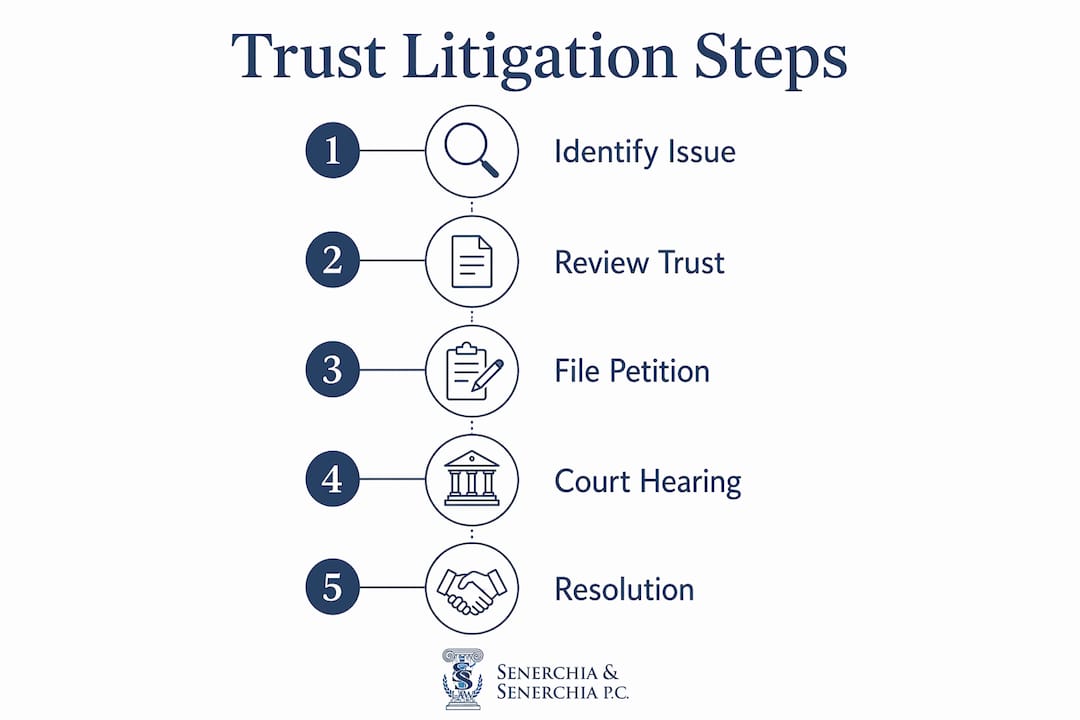
The litigation process typically begins when a beneficiary or interested party files a petition or complaint in superior court. From there, the court may order discovery, require the trustee to produce accountings, or schedule hearings to evaluate the merits of the claim. The process mirrors other civil equity proceedings, but the subject matter, trust assets and fiduciary conduct, requires specialized knowledge of trust law.
Key procedural steps in trust litigation include:
- Petition for accounting: A beneficiary asks the court to compel the trustee to produce a full financial accounting of trust assets and transactions.
- Surcharge claim: A beneficiary seeks monetary damages against a trustee for losses caused by mismanagement or breach of duty.
- Trustee removal: A party asks the court to remove the trustee based on misconduct, conflict of interest, or breach of loyalty.
- Trust interpretation: The court is asked to clarify ambiguous trust language or resolve disputes about the grantor’s intent.
- Injunctive relief: A party seeks a court order to stop the trustee from taking a specific action pending resolution of the dispute.
Pro Tip: Document every communication with your trustee in writing. Courts weigh written records heavily when evaluating whether a trustee responded appropriately to beneficiary inquiries.
What are the common reasons for trust disputes in Rhode Island?
Breach of fiduciary duty is the most common ground for trust litigation in Rhode Island. A trustee holds a position of legal trust and must act in the best interests of all beneficiaries, not just the ones receiving current income. When that duty breaks down, litigation follows.
Common grounds for trust disputes include:
- Self-dealing: The trustee uses trust assets for personal benefit, such as buying trust property at below-market value.
- Failure to diversify: The trustee holds a concentrated or declining asset when prudent management would require selling or rebalancing.
- Improper distributions: The trustee favors one beneficiary class over another without legal justification.
- Failure to account: The trustee refuses or neglects to provide beneficiaries with financial records.
- Breach of impartiality: The trustee prioritizes income beneficiaries at the expense of remaindermen, or vice versa.
The landmark case Dennis v. Rhode Island Hospital Trust National Bank illustrates how seriously courts take the duty of impartiality. In that case, the U.S. Court of Appeals upheld a $365,000 surcharge against a trustee who failed to sell depreciating real estate, favoring income beneficiaries while harming remaindermen. That outcome sent a clear message to trustees across the state.
“The trustee’s role is to follow the grantor’s intent impartially, not simply to please beneficiaries. Courts in Rhode Island take that duty seriously, and the financial consequences of getting it wrong can be severe.”
Beneficiaries also face a practical challenge that many do not anticipate. Beneficiaries in Rhode Island often struggle to obtain trust accounting without court intervention because no duty-to-inform statute exists. That means the first step in many disputes is not a trial but a petition simply to get the information needed to evaluate whether misconduct occurred.
What legal steps can Rhode Island beneficiaries and trustees take?
Beneficiaries who suspect mismanagement should act methodically rather than reactively. The absence of automatic disclosure rights means building a case requires court involvement from the start. Legal guidance is especially valuable in Rhode Island, where courts interpret trust principles case by case and procedural missteps can weaken an otherwise valid claim.
Steps beneficiaries can take include:
- File a petition for accounting in superior court to compel the trustee to disclose financial records.
- Retain a trust attorney to evaluate whether the disclosed records reveal grounds for a surcharge or removal claim.
- Request expert analysis of complex assets, such as real estate or business interests, to establish valuation and mismanagement.
- Explore mediation or alternative dispute resolution before proceeding to a full trial, which reduces cost and preserves family relationships.
Trustees facing claims also have options. A trustee can file a voluntary accounting with the court to demonstrate transparency and good faith. Trustees may also petition the court for instructions when trust language is ambiguous, which protects them from later claims of misinterpretation.
| Action | Who Initiates | Court Involved |
|---|---|---|
| Petition for accounting | Beneficiary | Superior Court |
| Surcharge claim | Beneficiary | Superior Court |
| Trustee removal | Beneficiary or co-trustee | Superior Court equity |
| Voluntary accounting | Trustee | Superior Court |
| Charitable trust enforcement | Attorney General | Superior Court |
For charitable trusts, the Rhode Island Attorney General has authority to investigate compliance and maintains a public database of charitable trust filings. That public record can inform private litigation decisions when a charitable trust is involved.
Pro Tip: If you are a trustee managing real estate or business interests inside a trust, get periodic independent appraisals. Courts scrutinize asset valuations closely in surcharge claims, and documented appraisals are your best defense.
How does trust litigation affect families pursuing a claim?
Trust disputes carry real emotional weight. They often arise within families already grieving a loss, and the legal process can deepen those fractures. Understanding the practical realities before filing a claim helps families make informed decisions rather than reactive ones.
Key considerations before pursuing trust litigation include:
- Cost: Superior court equity proceedings require attorney fees, expert witnesses for complex asset valuations, and court costs that can accumulate quickly.
- Time: Trust litigation in Rhode Island can take months or years, depending on the complexity of the dispute and the court’s docket.
- Unpredictability: Because Rhode Island relies on common law rather than statute, outcomes depend heavily on how a judge interprets prior case decisions.
- Relationships: Litigation between family members over a trust can cause lasting damage to personal relationships that no court order can repair.
- Alternatives: Mediation and negotiated settlements often resolve trust disputes faster, at lower cost, and with less family conflict than full litigation.
Exploring a living trust setup before disputes arise is one of the most effective ways to reduce the risk of litigation. Clear trust language, proper trustee selection, and regular reviews eliminate many of the ambiguities that lead to court.
Key Takeaways
Trust litigation in Rhode Island is governed by common law, not statute, which makes specialized legal counsel the single most important factor in any trust dispute.
| Point | Details |
|---|---|
| Common law governs disputes | Rhode Island has no comprehensive trust code; courts decide case by case using equity principles. |
| No automatic disclosure rights | Beneficiaries must petition the court to compel trustee accounting without a duty-to-inform statute. |
| Impartiality is a core duty | Trustees must balance income beneficiaries and remaindermen equally, as confirmed in Dennis v. Rhode Island Hospital Trust. |
| Removal requires serious misconduct | Negligence alone does not justify trustee removal; courts require proof of breach, self-dealing, or conflict of interest. |
| Early legal counsel is critical | Procedural missteps in information petitions can weaken a surcharge or removal claim before trial begins. |
What I’ve learned about trust litigation that most families don’t expect
Most families who come to me with a trust dispute share the same frustration: they assumed being a beneficiary meant they had the right to know what was happening with the trust. Rhode Island law does not guarantee that. Beneficiaries do not have an absolute right to trust information under Rhode Island law, and that surprises nearly everyone.
The practical lesson is this: your first legal move in a trust dispute is almost never a trial. It is a petition for information. Building the evidentiary record through court-ordered accountings is what makes a surcharge or removal claim viable later. Families who skip that step and go straight to aggressive claims often find themselves without the documentation to support them.
I also see trustees underestimate the duty of impartiality. Managing a trust is not about keeping the peace between family members. It is about following the grantor’s intent with equal regard for every beneficiary class. The Dennis case is a reminder that holding onto a declining asset because it generates income for one group, while eroding value for another, is a breach that courts will not overlook.
My honest advice: consult an attorney before you send a single letter to a trustee or respond to a beneficiary’s demand. The steps you take in the first weeks of a dispute shape everything that follows. You can also review a solid estate planning checklist to understand how well-drafted documents prevent these conflicts from arising in the first place.
— Anthony
How Senerchia & Senerchia Law helps with trust disputes in Rhode Island
Trust litigation is one of the most procedurally demanding areas of Rhode Island law, and the stakes for families are high. Senerchia & Senerchia Law works with beneficiaries and trustees throughout Rhode Island to address trust disputes, petition for accountings, evaluate surcharge claims, and navigate the superior court equity process. The firm also helps families build estate planning documents that reduce the risk of future disputes by establishing clear trustee duties, distribution terms, and successor provisions from the start. If you are facing a trust conflict or want to protect your family’s assets before a dispute arises, contact Senerchia & Senerchia Law for a consultation. Proactive planning and experienced counsel make a measurable difference in outcomes.
FAQ
What is trust litigation in Rhode Island?
Trust litigation in Rhode Island is the legal process of resolving disputes over trust administration, asset management, or distribution through superior court equity proceedings, governed primarily by common law.
Can a beneficiary force a trustee to provide financial records in Rhode Island?
Beneficiaries have no automatic right to trust information under Rhode Island law. They must petition the court to compel the trustee to produce an accounting.
What grounds justify removing a trustee in Rhode Island?
Trustee removal requires proof of significant misconduct such as breach of duty, self-dealing, or conflict of interest. Negligence alone is not sufficient grounds for removal in Rhode Island courts.
What is a surcharge claim in a trust dispute?
A surcharge claim is a legal action seeking monetary damages from a trustee for losses caused by mismanagement or breach of fiduciary duty, such as failing to sell a declining asset held in trust.
Does the Rhode Island Attorney General oversee all trusts?
The Rhode Island Attorney General oversees charitable trust compliance only. Private family trusts fall under superior court equity jurisdiction, not the Attorney General’s office.