


A probate surety bond is defined as a court-mandated financial guarantee requiring an executor or administrator to manage estate assets lawfully and distribute them according to Rhode Island law. The bond protects beneficiaries and creditors from losses caused by fiduciary mismanagement or fraud. In Rhode Island, the role of surety bond in probate is not optional in most cases. Without it, a fiduciary cannot access bank accounts, sell assets, or take any action on behalf of the estate.
Think of the bond as a financial backstop. If an executor misappropriates funds or fails to pay valid creditors, the bond provides a source of recovery. The surety company pays the claim first, then seeks reimbursement from the fiduciary. This three-party structure, involving the fiduciary, the court or beneficiaries, and the surety company, is what gives the bond its legal force.
What is the role of surety bond in probate?
A probate surety bond, also called a fiduciary bond or executor bond, serves as a financial guarantee that the person managing the estate will pay debts, value assets accurately, and distribute property as required by law. The bond does not protect the fiduciary. It protects everyone else: the heirs, the creditors, and the court itself.
Rhode Island probate workflow follows a specific sequence. You file the will and petition, post the surety bond as required, and then receive the Certificate of Appointment. That certificate is what gives you legal authority to act. Without the bond posted first, the court will not issue it.

The importance of surety bonds in this context goes beyond paperwork. They replace informal trust with enforceable financial accountability. A beneficiary who suspects mismanagement has a concrete remedy: file a claim against the bond. That changes the entire dynamic of estate administration.
Who must obtain a probate bond in Rhode Island?
Executors named in a will and administrators appointed when there is no will both generally must post a bond in Rhode Island. The specific circumstances that trigger or waive the requirement include:
- Executors with a will: The will itself may waive the bond requirement. Many estate planning attorneys draft wills with explicit waiver language to spare the executor this step.
- Administrators without a will: Courts almost always require a bond when someone dies intestate, because there is no document expressing the decedent’s wishes about who to trust.
- Court discretion: Even when a will waives the bond, courts retain discretion to require one if creditor concerns exist, if beneficiaries are minors, or if the estate involves significant complexity or conflict.
- Beneficiary waiver: All adult beneficiaries may unanimously consent to waive the bond, but this requires every single beneficiary to agree in writing. One holdout eliminates this option.
- Corporate fiduciaries: Banks and trust companies acting as executors are typically exempt from bond requirements because they are already regulated and bonded under separate financial laws.
Pro Tip: If you are drafting a will and want to spare your executor the cost and delay of bonding, ask your attorney to include explicit bond waiver language. This one sentence in a will can save your estate hundreds of dollars and weeks of time.
Courts do not grant waivers lightly when risk factors exist. A history of financial difficulty, a contested estate, or creditors actively pursuing claims can all prompt a judge to require a bond regardless of what the will says.
How do probate surety bonds work?
The bond involves three parties, each with a defined legal role.
- The principal is the fiduciary: the executor or administrator. This person applies for the bond, pays the premium, and bears full financial responsibility for reimbursing the surety if a claim is paid out.
- The obligee is the court and, by extension, the beneficiaries and creditors the court represents. They are the protected parties. If the fiduciary causes a loss, the obligee has the right to make a claim against the bond.
- The surety is the bonding company or insurance carrier that issues the bond. The surety pays valid claims up to the bond amount, then pursues the fiduciary for full reimbursement.
This structure is fundamentally different from standard insurance. With insurance, the policyholder is protected from their own losses. With a surety bond, the fiduciary is not protected at all. The bond exists entirely to protect others from the fiduciary’s potential failures.
Claims against the bond can be filed when a fiduciary misappropriates estate funds, fails to pay valid debts, distributes assets incorrectly, or otherwise breaches their legal duties. The surety investigates the claim, and if it is valid, pays the loss. The fiduciary then owes that amount back to the surety in full. This reimbursement obligation is what gives the bond real deterrent power.
Pro Tip: If you are named as executor and you have concerns about your own financial exposure, speak with an attorney before accepting the role. Understanding your reimbursement obligations under the bond is critical before you sign anything.
For estates with significant conflict or high asset values, probate bonds provide enforceable consequences that empower courts to oversee fiduciaries with real financial teeth. This is especially relevant in Rhode Island estates where family disputes are common.
How do you obtain a probate bond in Rhode Island?
Securing a probate bond involves several concrete steps. Preparing early makes the difference between a smooth process and a delayed estate.
- Gather estate documentation. You will need an inventory of the estate’s personal property, the will (if one exists), the court petition, and your personal financial information. The bond amount in Rhode Island is typically equal to the personal property value, so an accurate inventory matters.
- Submit an application to a surety company. The surety will conduct a credit check and background review. Underwriting evaluates your financial history because the surety needs confidence that you can reimburse a claim if one arises.
- Receive approval and pay the premium. For creditworthy applicants, issuance often occurs same day or next day. Poor credit or complex estates may take longer. Premiums are calculated per $1,000 of bond coverage, with a structure similar to roughly $2.50 per $1,000 bonded in comparable states, though Rhode Island costs vary.
- File the bond with the probate court. The court records the bond before issuing your Certificate of Appointment.
- Renew annually if needed. The bond remains in force until the court releases it after final accounting and asset distribution. If administration extends beyond one year, you pay renewal premiums. Efficient estate administration directly reduces your total bonding cost.
| Step | What it involves |
|---|---|
| Estate inventory | Document all personal property to establish the required bond amount |
| Application | Submit financial and estate details to a surety company for underwriting |
| Credit review | Surety conducts background and credit checks on the fiduciary |
| Bond issuance | Approved bond is issued, often same day for qualified applicants |
| Court filing | Bond is filed with the probate court before the Certificate of Appointment issues |
| Annual renewal | Premiums renew each year until the court formally releases the bond |
What happens if you fail to post a probate bond?
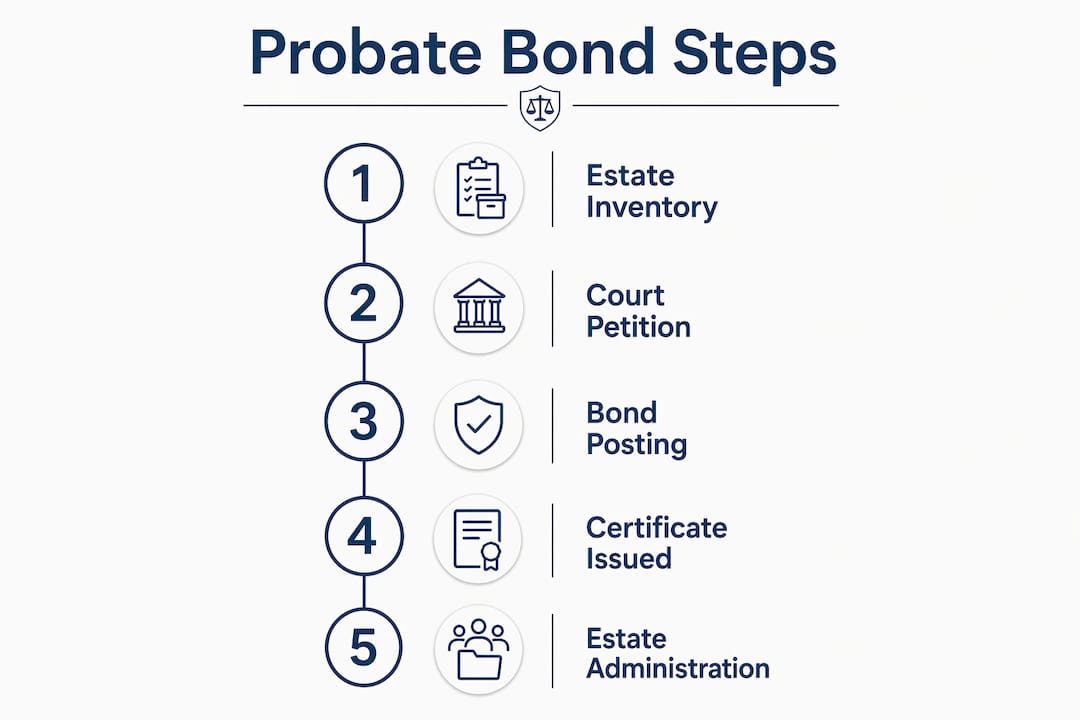
The consequences are immediate and serious. Failure to post a bond blocks fiduciary authority entirely. You cannot access bank accounts, manage investments, pay estate debts, or take any legal action on behalf of the estate until the bond is in place.
If the delay continues, the court has the authority to revoke your appointment and name a replacement fiduciary. That replacement will likely be a stranger to your family, and they will charge professional fees for their services. The estate bears those costs.
Beyond the legal consequences, bonding delays create practical problems:
- Creditors may begin collection actions while the estate sits unmanaged.
- Real estate taxes and maintenance costs continue to accrue on estate property.
- Beneficiaries face extended waiting periods before receiving their inheritance.
- Court-imposed deadlines for inventory and accounting can be missed, triggering additional court involvement.
The bond is not a formality you can circle back to later. It is the gatekeeper that opens the door to every other step in the Rhode Island probate process.
How does Rhode Island compare to other states on bond requirements?
Rhode Island requires a bond equal to the estimated personal property value of the estate unless the will waives it or the court grants an exception. This is a straightforward, asset-based calculation. Real property is handled separately through recording fees and deed transfers, not through the bond amount.
States that have adopted the Uniform Probate Code, such as Alaska, Arizona, and Colorado, take a different default approach. Under the UPC, bonds are generally not required unless the will demands one or a beneficiary requests it. Rhode Island has not adopted the UPC, so the default here leans toward requiring the bond rather than waiving it.
| Jurisdiction | Default bond requirement | Waiver mechanism |
|---|---|---|
| Rhode Island | Required unless will waives it | Will language or unanimous beneficiary consent |
| UPC states (e.g., Arizona) | Not required by default | Will or beneficiary can request one |
| Most non-UPC states | Required in most cases | Court discretion, will language, or consent |
| Corporate fiduciaries | Generally exempt in most states | Regulated separately under financial law |
Rhode Island courts also maintain broader discretion than UPC states to override waivers. Even with a valid waiver in the will, a Rhode Island probate judge can reinstate the bond requirement if the circumstances warrant it. This reflects a protective philosophy that prioritizes beneficiary and creditor safety over administrative convenience.
Key takeaways
A probate surety bond in Rhode Island is a legal prerequisite that gates fiduciary authority, protects beneficiaries and creditors, and must be secured before any estate assets can be touched.
| Point | Details |
|---|---|
| Bond is a prerequisite | No bond means no Certificate of Appointment and no authority over estate assets. |
| Rhode Island default requires bonds | Bonds equal personal property value unless the will or court grants a waiver. |
| Three-party structure | Principal, obligee, and surety each carry defined legal roles and obligations. |
| Waivers are not absolute | Courts can override will-based waivers when creditor or beneficiary concerns exist. |
| Early preparation reduces delays | Gathering documentation and applying early prevents probate timeline setbacks. |
Why I think most families underestimate the bond requirement
Most people I work with in Rhode Island probate have never heard the term “surety bond” before they are named executor. They assume the hard part is finding the will or dealing with the family. The bond catches them off guard, and that surprise costs time and money.
What I have observed over years of estate work is that the bond is not just a legal checkbox. It is the moment where informal family trust gets replaced by formal financial accountability. That shift matters. It protects the executor as much as the beneficiaries, because it creates a documented structure for every decision made with estate funds.
The families who move through probate most smoothly are the ones who treat the bond as step one, not an afterthought. They gather the estate inventory early, they check whether the will has waiver language, and they contact a surety company before the court hearing. That preparation turns a potential two-week delay into a same-day approval.
One thing I want to be direct about: a will waiver is not a guarantee. I have seen Rhode Island courts require bonds in estates where the will explicitly waived them, because a creditor raised concerns or because the estate had unusual complexity. Do not assume the waiver language protects you from the requirement. Verify with an attorney before you proceed.
The bond is also a signal to beneficiaries that the process is being handled correctly. When a family member is grieving and worried about whether the estate will be managed fairly, knowing a financial guarantee is in place provides real comfort. That is worth something beyond the legal mechanics.
— Rich
Get help with Rhode Island probate and estate planning
Probate bond requirements in Rhode Island are specific, and the stakes for getting them wrong are real. At Sslawne, Senerchia & Senerchia P.C. guides families through every step of estate administration, from understanding bond requirements to filing with the probate court and managing the full distribution process. Whether you are an executor trying to figure out your obligations or a beneficiary concerned about how an estate is being handled, our team provides clear, personalized guidance. Explore our estate planning services or review common estate planning pitfalls to understand what to watch for. Schedule a risk-free 15-minute discovery call to talk through your situation with an experienced Rhode Island attorney.
FAQ
What is a probate surety bond?
A probate surety bond is a financial guarantee that an executor or administrator will manage estate assets lawfully and distribute them correctly. It protects beneficiaries and creditors from losses caused by fiduciary mismanagement or fraud.
Is a surety bond always required in Rhode Island probate?
Rhode Island requires a bond equal to the estate’s personal property value unless the will includes a waiver or the court grants an exception. Courts retain discretion to require a bond even when a will waives it.
How much does a probate bond cost in Rhode Island?
Bond premiums are calculated per $1,000 of coverage and renew annually until the court releases the bond after final accounting. The total cost depends on the estate’s personal property value and how long administration takes.
What happens if an executor does not get a bond?
Without a bond, the probate court will not issue a Certificate of Appointment, meaning the executor has no legal authority to access accounts or manage assets. Continued failure to post the bond can result in the court revoking the appointment entirely.
Can a will eliminate the need for a probate bond?
A will can include language waiving the bond requirement, but this is not absolute. Rhode Island courts can override the waiver if creditor concerns, beneficiary disputes, or estate complexity justify requiring one.