


TL;DR:
- A Rhode Island estate plan includes legal documents that govern asset transfer, protection, and management after death or incapacity. Proper planning involves understanding municipal probate, federal and state estate taxes, beneficiary designations, and special considerations for business and digital assets. Working with experienced attorneys ensures these elements are correctly coordinated to safeguard your family and assets.
A Rhode Island estate plan is defined as the legally binding set of documents and instructions that determines how your assets are managed, transferred, and protected after death or incapacity. The complete Rhode Island estate planning checklist covers five critical areas: core legal documents, probate procedures, state estate taxes, beneficiary designations, and special planning for business owners and digital assets. Rhode Island has its own rules that differ sharply from federal law and neighboring states, including a state estate tax exemption well below the federal threshold and a unique municipal probate system. Getting these details right protects your family and your assets.
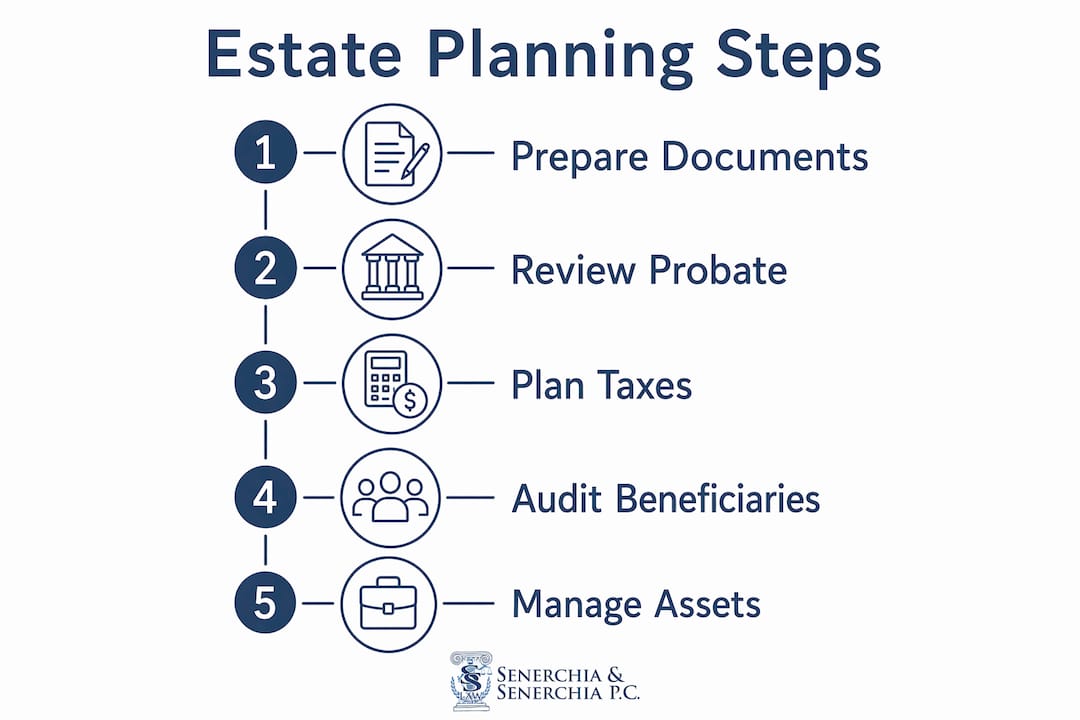
What are the core documents in a rhode island estate plan?
Every solid Rhode Island estate plan starts with four essential estate documents: a Last Will and Testament, a Durable Financial Power of Attorney, a Healthcare Directive, and a HIPAA Authorization. Each one serves a distinct purpose, and missing any one of them creates a gap that courts or family members may struggle to fill.

Your Last Will and Testament directs who receives your property and, if you have children, names a guardian for them. Rhode Island requires two witnesses to validly execute a will, and the executor files the original will along with a death certificate with the local probate court. Rhode Island will preparation is not complicated, but it must follow these exact steps to be legally valid.
Your Durable Financial Power of Attorney names someone to manage your finances if you become incapacitated. Your Healthcare Directive (also called a living will or healthcare proxy) names a healthcare agent and records your medical wishes. Your HIPAA Authorization gives that agent legal access to your medical records. Without it, even a named healthcare agent can be blocked from getting information from hospitals or doctors.
Core estate plan documents should be reviewed every 3–5 years or after any major life event such as a marriage, divorce, birth, or significant change in assets. A document that was accurate five years ago may no longer reflect your wishes or your family’s situation.
Pro Tip: Name both a primary and a backup (successor) agent for your financial and healthcare powers of attorney. If your primary agent is unavailable or unwilling to serve, a successor agent steps in without requiring court intervention.
Key roles to designate in your plan include:
- Executor: Administers your estate through probate and carries out your will’s instructions
- Healthcare Agent: Makes medical decisions on your behalf if you cannot
- Financial Agent: Manages your finances under your power of attorney
- Trustee: Manages any trust assets you establish for beneficiaries
- Guardian: Cares for minor children if both parents are deceased
How does rhode island probate work?
Rhode Island probate is administered at the municipal level, meaning each of the state’s 39 cities and towns operates its own probate court. This is a detail that surprises many families. Unlike most states where probate is handled at the county level, Rhode Island executors must file with the specific city or town where the deceased person lived, and each municipality may have slightly different local procedures.
The executor’s core probate steps follow this sequence:
- File Form PC-1.5 with the local probate court along with the original will and death certificate
- Pay the probate filing fee, calculated at 1% of personal property value, with a $30 minimum and a $1,500 maximum
- Publish a notice to creditors in a local newspaper as required by Rhode Island law
- Prepare a complete inventory of all probate assets and their fair market values
- Pay valid debts, taxes, and administrative expenses from estate funds
- File a final accounting with the probate court showing all receipts and disbursements
- Distribute remaining assets to beneficiaries as directed by the will
The fee structure is worth understanding before you begin. A $150,000 personal property estate pays $1,500 in filing fees. An estate with $500,000 in personal property still pays only $1,500 because that is the statutory maximum. Real estate value is not included in the fee calculation, but real estate does pass through probate unless it is held in a trust or jointly titled.
| Estate Personal Property Value | Probate Filing Fee |
|---|---|
| Under $3,000 | $30 (minimum) |
| $50,000 | $500 |
| $100,000 | $1,000 |
| $150,000 or more | $1,500 (maximum) |
Pro Tip: Rhode Island does not allow transfer-on-death (TOD) deeds for real estate. If you own a home and want to keep it out of probate, a revocable living trust is the most reliable strategy available to you under current Rhode Island law.
For more detail on executor responsibilities, including surety bond requirements, the surety bond in probate guide from Senerchia & Senerchia Law covers the full picture.
What are rhode island’s estate tax rules and asset protection strategies?
Rhode Island imposes its own state estate tax, and the exemption is far lower than most people expect. The 2026 Rhode Island estate tax exemption is $1,838,056, with graduated rates ranging from 0.8% to 16%. The federal estate tax exemption in 2026 is approximately $13.61 million. That gap is enormous, and it catches many Rhode Island families off guard.
Many Rhode Island residents assume they are exempt from state estate taxes because their estate falls well below the federal threshold. In reality, a home, retirement accounts, and life insurance proceeds can push a modest estate over the state’s $1,838,056 limit, triggering a tax bill that proper planning could have avoided entirely.
Rhode Island also offers no portability of the estate tax exemption between spouses. In states with portability, a surviving spouse can use the deceased spouse’s unused exemption. Rhode Island does not allow this. That means a married couple with a combined estate over $1,838,056 must plan proactively or risk losing one full exemption when the first spouse dies.
| Feature | Rhode Island | Federal (2026) |
|---|---|---|
| Estate Tax Exemption | $1,838,056 | ~$13,610,000 |
| Spousal Portability | No | Yes |
| Inheritance Tax | None | None |
| Gift Tax | None | Yes |
| Top Tax Rate | 16% | 40% |
The primary tool for married couples is a credit shelter trust (also called a bypass trust). When the first spouse dies, assets up to the exemption amount flow into the trust rather than directly to the surviving spouse. Those assets are sheltered from estate tax in the surviving spouse’s estate. This strategy effectively doubles the amount a married couple can pass to heirs free of Rhode Island estate tax.
Irrevocable trusts serve a different purpose. Assets transferred into an irrevocable trust are generally removed from your taxable estate, which reduces your exposure to both the Rhode Island estate tax and potential creditor claims. Rhode Island has no state inheritance tax and no state gift tax, which gives you flexibility to transfer assets during your lifetime as part of a broader asset protection plan.
How do you audit beneficiary designations in your estate plan?
Beneficiary designations on life insurance policies, IRAs, and 401(k) accounts override your will entirely. This is one of the most consequential and most overlooked facts in estate planning. A will that carefully distributes your assets means nothing if a beneficiary form on a retirement account directs those funds elsewhere.
Common errors that create serious problems include:
- Outdated designations after divorce: An ex-spouse named as beneficiary on a life insurance policy may still receive the proceeds, depending on the policy and applicable law
- No contingent beneficiary named: If your primary beneficiary dies before you and no contingent is listed, the asset may fall into your probate estate
- Naming a minor child directly: Minors cannot legally receive large sums. A court-appointed guardian of the property will manage the funds until the child reaches adulthood, which adds cost and delay
- Naming your estate as beneficiary: This forces retirement accounts through probate and eliminates the tax advantages of inherited IRA rules
Clearly named and regularly audited beneficiaries prevent unintended distributions that cause family disputes and extend probate. Review every beneficiary designation after a marriage, divorce, birth, death, or significant change in your financial picture. Coordinate your beneficiary forms with your will and any trusts so that assets flow where you intend. Your attorney can help you map out how each asset transfers and catch conflicts before they become problems.
For a deeper look at how outdated designations put families at risk, the beneficiary designation risks resource from Senerchia & Senerchia Law walks through real scenarios worth reading.
What special considerations apply to business owners and digital assets?
Business owners in Rhode Island face estate planning challenges that go beyond a standard will. Without the right documents in place, a business can stall, lose value, or create conflict among heirs when an owner dies or becomes incapacitated.
Key planning steps for business owners include:
- Buy-sell agreements: These legally binding contracts govern what happens to a business interest when an owner dies, becomes disabled, or wants to exit. They set a valuation method and a funding mechanism, often life insurance, so the transition is orderly
- Business succession plans: A written succession plan identifies who takes over management and ownership, and on what timeline. Without one, courts and family members are left to figure it out under pressure
- Durable power of attorney with business authority: A standard financial power of attorney may not cover business decisions. Make sure yours explicitly authorizes your agent to manage business accounts, sign contracts, and make operational decisions
Digital assets are a newer but equally important category. Your estate likely includes email accounts, cloud storage, cryptocurrency, social media profiles, and subscription services. Without a digital asset authority clause in your will, your executor may be legally blocked from accessing these accounts due to platform terms of service and federal privacy laws.
Pro Tip: Create a secure digital inventory that lists your accounts, usernames, and access instructions. Store it with your estate documents or in a password manager that your executor can access. This document alone can save your family weeks of frustration.
Executors without explicit digital authority are often limited to non-content metadata, meaning they can see that an account exists but cannot access its contents. For cryptocurrency, this limitation can mean permanent loss of assets. A digital estate planning strategy that includes authority clauses and a documented asset inventory closes this gap before it becomes a crisis.
For business owners specifically, connecting your succession plan with your personal estate plan is something the Rhode Island business formation team at Senerchia & Senerchia Law handles regularly.
Key takeaways
A complete Rhode Island estate plan requires core legal documents, a clear understanding of municipal probate, proactive estate tax planning, and regular audits of beneficiary designations to protect your family and assets.
| Point | Details |
|---|---|
| Four core documents | Every plan needs a will, financial POA, healthcare directive, and HIPAA authorization. |
| Municipal probate system | Rhode Island’s 39 town-level probate courts each have local procedures executors must follow. |
| State estate tax threshold | Rhode Island taxes estates over $1,838,056 at rates up to 16%, with no spousal portability. |
| Beneficiary designations override wills | Review all life insurance and retirement account designations after every major life event. |
| Digital and business assets need explicit authority | Include digital asset clauses and business succession documents to prevent access gaps and disputes. |
Work with senerchia & senerchia law on your estate plan
Senerchia & Senerchia Law has guided Rhode Island individuals, families, and business owners through every stage of estate planning for years. The firm handles will drafting, trust creation, probate administration, and tax planning tailored to Rhode Island’s specific laws. If you are concerned about common estate planning mistakes that families make, or you need a full review of your beneficiary designations and business succession documents, Senerchia & Senerchia Law provides the personalized attention your plan deserves. Reach out to schedule a consultation and build an estate plan that reflects your goals, protects your assets, and gives your family clarity when they need it most.
FAQ
What documents are required for a rhode island estate plan?
A complete Rhode Island estate plan requires a Last Will and Testament, a Durable Financial Power of Attorney, a Healthcare Directive, and a HIPAA Authorization. Business owners should also include buy-sell agreements and a succession plan.
How does rhode island probate differ from other states?
Rhode Island probate is handled by 39 municipal courts rather than county courts, requiring executors to file with the specific city or town where the deceased resided. The filing fee is 1% of personal property value, capped at $1,500.
What is the rhode island estate tax exemption for 2026?
The Rhode Island estate tax exemption for 2026 is $1,838,056, with rates from 0.8% to 16%. Rhode Island does not offer spousal portability, making credit shelter trusts a critical planning tool for married couples.
Can i avoid probate for my home in rhode island?
Rhode Island does not allow transfer-on-death deeds for real estate, so a revocable living trust is the primary strategy for keeping a home out of probate court while maintaining control during your lifetime.
Do beneficiary designations override my will in rhode island?
Yes. Beneficiary designations on life insurance, IRAs, and 401(k) accounts override your will entirely. Reviewing and updating these designations after every major life event is one of the most important steps in any Rhode Island estate planning guide.