


Resolving creditor claims against a probate estate is a required legal step before any assets can pass to heirs, and understanding wills and estates is crucial in this process. As the personal representative (also called the executor), your job is to identify who the decedent owed money to, notify those creditors, evaluate each claim, and pay valid debts in the correct order. Only after that process is complete can you distribute what remains. Get it wrong, and you can face personal financial liability. Here is what the process looks like in practice, with specific guidance for Rhode Island and New England.
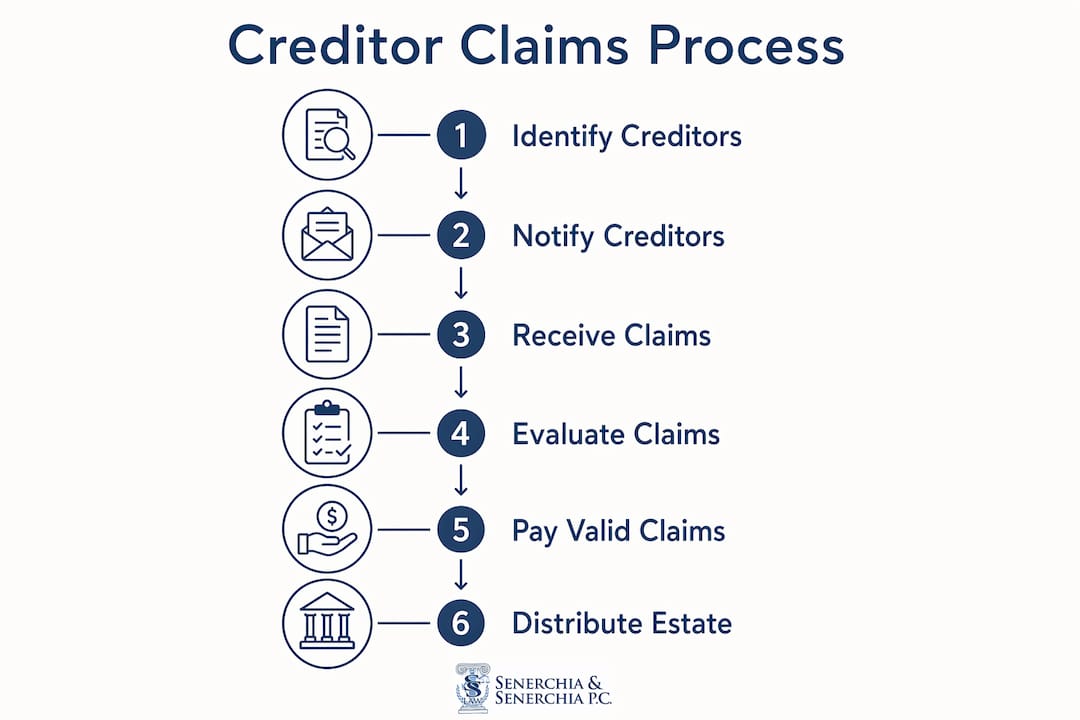
The core steps every executor must follow are:
- Identify all known and potential creditors by reviewing the decedent’s mail, bank statements, and financial records.
- Publish a notice to creditors in a local newspaper to start the statutory claim period.
- Send direct written notice to known creditors such as mortgage lenders, credit card companies, and medical providers.
- Review each claim filed, then accept, partially accept, or reject it in writing.
- Pay valid claims in statutory priority order before making any distributions to beneficiaries.
How do creditor claims work in a probate estate?
Creditor claims in probate fall into two broad categories. Informal claims are simple written statements of the amount owed, often submitted directly to the executor. Formal claims are filed with the probate court and carry more procedural weight, especially when the executor disputes them.
Common claim types include medical bills, credit card balances, mortgages, unpaid taxes, funeral expenses, and outstanding contractor invoices. Debts follow a statutory priority order, with funeral and medical expenses typically ranking above general creditor claims.
The executor’s responsibilities go beyond just paying bills. You must actively identify creditors, issue proper notices, maintain records of every claim received, and evaluate each one for validity. Ignoring a legitimate claim or paying creditors out of order can expose you to personal liability for the resulting shortfall.
What are the creditor claim deadlines in New England states?
Deadlines vary significantly across New England, and missing them has serious consequences for both creditors and executors.
| State | Claim Period | Measured From | Key Notes |
|---|---|---|---|
| Rhode Island | 6 months | First publication of probate notice | Late claims allowed only for excusable neglect, with court approval |
| Massachusetts | 1 year from death | Date of decedent’s death | No final distribution permitted before this period ends |
| Connecticut | 150 days (90 days for specific creditors with direct notice) | Date of fiduciary appointment | Direct notice to a specific creditor can shorten this period, but not to less than 90 days |
Rhode Island estates must remain open for at least six months to accommodate the creditor claim window. In Massachusetts, probate typically spans 9–18 months partly because the one-year creditor bar runs alongside all other administration work, and no final distribution is permitted before it expires. Connecticut’s 150-day period runs automatically from the date of fiduciary appointment, but direct notice to a specific creditor can shorten this period to no less than 90 days. Connecticut executors need to start identifying creditors immediately after appointment.
Understanding state-specific claim timelines is one of the most practical things you can do to protect yourself and the estate.
How should you respond to creditor claims during probate?
When a claim arrives, confirm receipt and verify the creditor’s identity and the supporting documentation. Then choose one of three responses: accept the claim and schedule payment, partially accept it if you dispute the amount but acknowledge some obligation, or reject it entirely with written notice to the creditor.

Silence is not rejection. You must affirmatively respond to every claim. A creditor whose claim is rejected can pursue the matter in court, with complex disputes typically resolved in Superior Court rather than probate court.
Pay accepted claims in statutory priority order. Funeral expenses and medical costs generally come first, followed by government debts, then general creditors. Premature distribution before the claim period ends is the single biggest risk executors face. If a legitimate creditor surfaces after you have already paid beneficiaries, you can be ordered to reimburse the estate from your own funds.
Pro Tip: Start your creditor search on day one by pulling the decedent’s last six months of bank statements, credit card bills, and any recurring payment records. This surfaces most known creditors before the claim period even begins, giving you time to send direct notices and avoid surprises.
How Senerchia & Senerchia Law guides Rhode Island executors through creditor claims
Serving as an executor in Rhode Island or Southern New England carries real legal exposure, and the creditor claims phase is where most mistakes happen. Senerchia & Senerchia Law works directly with personal representatives to identify creditors early, issue proper notices, and evaluate each claim before any distributions are made.
The firm’s probate administration practice covers the full range of creditor claim issues, from disputed medical bills to Medicaid recovery claims and contested contract debts. Their attorneys understand Rhode Island’s six-month claim window, Massachusetts’ one-year bar, and Connecticut’s 150-day period, and they apply that knowledge to protect executors at every stage.
How does resolving creditor claims affect distributions to heirs?
Heirs receive nothing until all valid debts and administration expenses are paid. This is not a technicality. It is the legal structure of probate. If the estate lacks sufficient assets to cover all claims, payment follows a statutory priority order, and some beneficiaries may receive less than expected or nothing at all. Connecticut executors must also obtain tax clearance from the Department of Revenue Services before any distributions occur.
The practical result is that heirs often wait longer than they anticipate. In Massachusetts, that wait is at least one year from the date of death. Planning for this timeline, and communicating it clearly to beneficiaries, is part of the executor’s role.
How do you verify and dispute invalid or fraudulent creditor claims?
Not every claim filed against an estate is legitimate. Start by requesting full documentation: the original contract, account statements, invoices, or medical records that support the claimed amount. Compare the claim against the decedent’s own financial records to check for inconsistencies.

If a claim appears inflated or fabricated, reject it in writing and document your reasoning. The creditor then bears the burden of pursuing the matter in court. For claims that seem partially valid, a partial acceptance with written explanation is often the most practical path. When fraud is suspected, consult with a probate attorney before responding, since a formal rejection that is later challenged in Superior Court will require solid documentation to defend.
How do you notify creditors of a probate estate?
Known creditors receive direct written notice as soon as the estate is opened. For Rhode Island estates, the personal representative must also publish a notice in a local newspaper under RI Gen L § 33-11-5, which starts the six-month claim period. Unknown creditors are reached through this published notice.
Connecticut requires notice under CGS 45a-354, with publication ordered by the probate court. Massachusetts follows similar dual-notice requirements under the Massachusetts Uniform Probate Code. Failing to provide adequate notice to a known creditor can expose the executor to personal liability for that unpaid debt, regardless of whether the claim period has closed.
Key Takeaways
Resolving creditor claims in a probate estate requires proper notice, timely responses, and payment in statutory priority order before any assets reach heirs.
| Point | Details |
|---|---|
| Creditor notice is mandatory | Executors must notify known creditors directly and publish notice for unknown creditors to start the claim period. |
| Deadlines differ by state | Rhode Island allows 6 months from first publication; Massachusetts bars claims after one year; Connecticut’s period is 150 days from fiduciary appointment. |
| Priority order governs payment | Funeral and medical expenses rank above general creditor claims; pay in statutory order to avoid personal liability. |
| Premature distribution is the top risk | Distributing assets before the claim period closes can make the executor personally responsible for later-surfacing debts. |
| Disputes go to court | Rejected claims can be litigated, typically in Superior Court for complex matters; document every decision carefully. |
FAQ
What is the creditor claim period in Rhode Island?
Rhode Island’s creditor claim period is 6 months from the date of first publication of the probate notice. Claims filed after this window are generally barred, though the court may allow late claims for excusable neglect.
Can an executor be personally liable for unpaid creditor claims?
Yes. An executor who distributes assets before the claim period ends, or who fails to notify known creditors, can be held personally responsible for debts that should have been paid from estate funds.
What happens to creditor claims if the estate has no money?
If the estate is insolvent, the executor pays claims in statutory priority order until assets are exhausted. Under Massachusetts General Laws Section 3-807, the personal representative must represent the estate as insolvent to the court and distribute remaining assets accordingly.
How does an executor dispute a fraudulent creditor claim?
Reject the claim in writing with documented reasoning, then preserve all supporting records. The creditor must then pursue the matter in court, where the burden shifts to them to prove the debt is valid.
Do heirs have to wait for creditor claims to be resolved before receiving assets?
Yes. No final distribution to beneficiaries is permitted until all valid claims are paid and, in states like Connecticut and Massachusetts, tax clearances are obtained. In Massachusetts, that means waiting at least one year from the date of death.
Handling creditor claims is one of the most consequential parts of estate administration in Rhode Island. If you are serving as an executor and want guidance specific to your situation, Senerchia & Senerchia Law is ready to help. Reach out to discuss your estate’s creditor claim obligations and protect yourself from personal liability throughout the process. You can also review the estate planning documents that can simplify administration long before probate begins.