


TL;DR:
- Creating legal barriers between personal assets and business liabilities is crucial for small business owners to prevent personal financial exposure. Forming an LLC or corporation, maintaining proper formalities, and obtaining adequate insurance form a multi-layered strategy that preserves asset protection. Advanced tools like trusts and strategic state choices further strengthen defenses, emphasizing the importance of proactive planning before any legal threat arises.
Protecting personal assets from business liability is defined as the legal and financial practice of creating barriers between what you own personally and what your business owes to others. Every small business owner faces real exposure: a slip-and-fall at your shop, a contract dispute, or a product claim can all become personal financial threats without the right protections in place. The good news is that tools like LLCs, corporations, liability insurance, and irrevocable trusts give you concrete ways to shield assets from liability before any claim ever arises. This guide walks you through each layer of protection, from entity formation to advanced trust planning, so you can build a strategy that actually holds up.
How do LLCs and corporations protect personal assets from business liabilities?
Operating through a separate legal entity like an LLC or corporation is the single most effective first step for business liability protection. When your business is properly formed and maintained, creditors pursuing a claim against the business are limited to the business’s assets, not your home, savings, or personal investments. This separation is the foundation of what attorneys call “limited liability,” and it is the reason most small business owners choose an LLC or corporation over a sole proprietorship or general partnership.

Sole proprietorships vs. limited liability entities
A sole proprietorship offers zero separation between you and your business. Every debt, lawsuit, and judgment against the business is also a judgment against you personally. A general partnership works the same way, and in many states each partner can be held fully liable for the other’s actions. An LLC or corporation changes this entirely by creating a separate legal “person” that owns the business assets and bears the business liabilities.
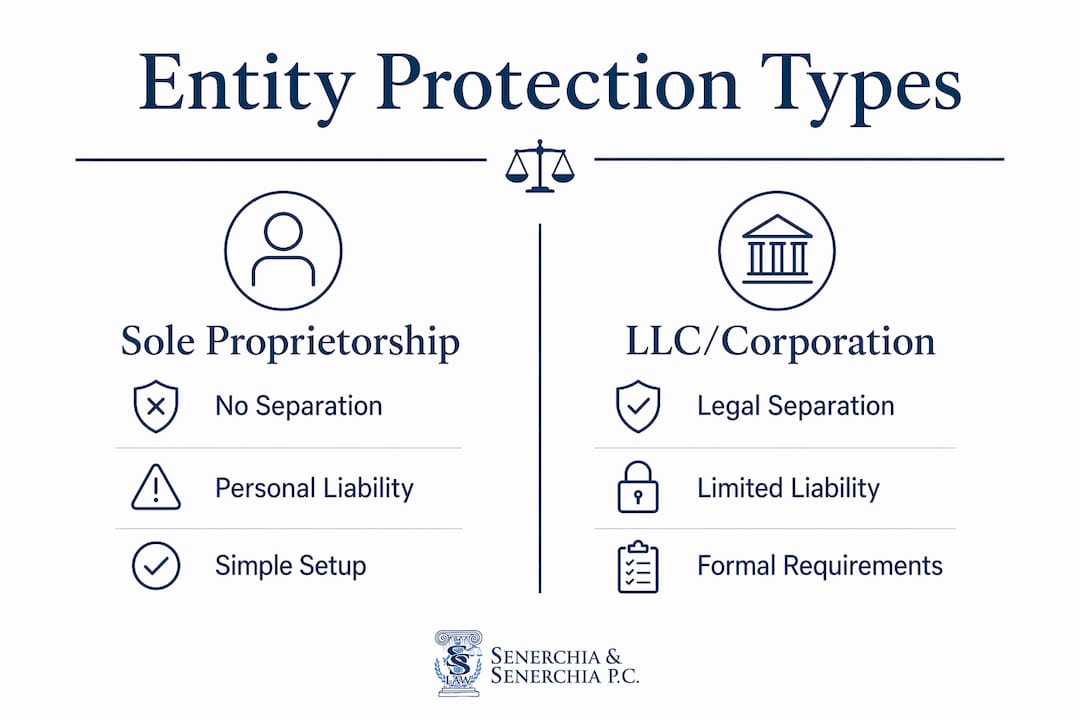
The differences between an LLC and a corporation matter less than most people think at the small business level. Both provide the core liability shield. LLCs tend to be simpler to operate and more flexible for tax purposes, while corporations, particularly S-corporations, may offer payroll tax advantages for owner-operators. The right choice depends on your specific situation, which is why consulting a business law attorney before forming your entity is worth the time.
What voids the protection
Failing to maintain entity formalities, commingling personal and business funds, signing personal guarantees, or undercapitalizing the business can all void the liability shield. Courts use a doctrine called “piercing the corporate veil” to hold owners personally liable when the business looks like nothing more than an extension of the owner. The key failure modes to avoid include:
- Commingling funds: Using your business account to pay personal bills, or depositing business income into your personal account, signals to courts that no real separation exists.
- Personal guarantees: Signing a lease, loan, or vendor contract personally makes you directly liable for that obligation regardless of your entity structure.
- Undercapitalization: Starting a business with no real assets or funding, then expecting the entity to absorb all liability, is a red flag courts take seriously.
- Ignoring formalities: Corporations must hold annual meetings and keep minutes. LLCs should follow their operating agreement. Skipping these steps weakens your legal position.
Pro Tip: Open a dedicated business checking account the same week you form your LLC or corporation. This single step is the most visible proof of separation and the easiest way to demonstrate to a court that you treat the business as a genuinely distinct entity.
Why does strict separation preserve your personal asset protection?
Courts evaluate entity separation by looking at how you actually operate the business day to day, not just how it was set up on paper. A well-drafted LLC operating agreement means very little if you routinely pay personal expenses from the business account or make major decisions without any documentation. The legal shield is only as strong as the habits behind it.
Here are the operational steps that keep your protection intact:
- Maintain separate accounts. Every business transaction, income deposit, and expense payment should flow through accounts held in the business’s name. This applies to credit cards as well.
- Document major decisions. For corporations, hold annual meetings and record minutes. For LLCs, document significant decisions in writing, even informally, to show the business operates independently.
- Sign contracts correctly. Always sign business contracts as “Jane Smith, Member, ABC LLC” rather than just “Jane Smith.” This signals to the other party and to courts that the entity, not you personally, is the contracting party.
- Capitalize the business adequately. Fund the business with enough capital to cover its foreseeable obligations. Undercapitalization is one of the most common reasons courts pierce the veil.
- Avoid personal guarantees where possible. When a lender or landlord demands a personal guarantee, negotiate. Sometimes it can be avoided or limited in scope.
Common estate planning mistakes like ignoring entity formalities or treating business and personal finances as interchangeable are among the most damaging errors a small business owner can make. They do not just create tax headaches. They can eliminate the very protection you formed the entity to get.
Pro Tip: Review your operating agreement or corporate bylaws once a year with your attorney. Business circumstances change, and an outdated agreement can create gaps in your protection that you would never notice until a claim arises.
How does insurance complement your entity’s liability shield?
Liability insurance works alongside your entity structure to create a second line of defense. Think of your LLC as a wall and your insurance as the moat in front of it. Even if a creditor finds a way to reach the entity’s assets, insurance can cover the claim before those assets are touched. The two tools work together, and relying on only one of them leaves meaningful gaps.
The most common types of business liability insurance include:
- General liability insurance: Covers bodily injury, property damage, and personal injury claims arising from your business operations. A customer injured at your location, or a contractor who damages a client’s property, falls under this coverage.
- Professional liability insurance: Also called errors and omissions (E&O) insurance, this covers claims that your professional advice or services caused financial harm. Consultants, accountants, designers, and healthcare providers typically need this coverage.
- Commercial umbrella insurance: Sits above your primary policies and extends coverage limits when a single claim exceeds the base policy. Personal umbrella coverage often starts at $1 million with modest annual premiums, making it one of the most cost-effective ways to safeguard personal finances from business risks.
- Workers’ compensation: Required in most states if you have employees, and it protects you from personal liability for workplace injuries.
Evaluating your insurance needs means looking honestly at the size of your claims exposure. A home-based consultant has different risk than a contractor with employees and heavy equipment. Work with an independent insurance broker who can compare policies across multiple carriers rather than one tied to a single company.
What advanced strategies should small business owners consider?
A layered asset protection approach combining entity structuring, insurance, statutory exemptions, and trusts yields the strongest personal asset safeguards. Once your basic entity and insurance layers are in place, these advanced tools can significantly strengthen your position.
Charging order protection and state differences
Charging order protection limits what a personal creditor can do with your LLC membership interest. Instead of seizing your ownership stake and taking over the business, the creditor is limited to receiving distributions if and when the LLC makes them. This is a powerful deterrent because a creditor stuck waiting for distributions that may never come has little practical leverage.
The strength of this protection varies significantly by state. Wyoming and Nevada are considered “exclusive remedy” states, meaning charging orders are the only tool available to personal creditors. California allows foreclosure on LLC interests in some scenarios, which is a weaker protection. If you operate in a state with limited charging order protections, forming your LLC in Wyoming or Nevada and registering as a foreign entity in your home state is a strategy worth discussing with an attorney.
| Strategy | Protection level | Best for |
|---|---|---|
| Single-member LLC | Moderate | Simple businesses in exclusive remedy states |
| Multi-member LLC | Stronger | Businesses with partners or added trust members |
| LLC plus irrevocable trust | Strongest | High-net-worth owners with significant personal assets |
| Domestic asset protection trust (DAPT) | Very strong | Long-term wealth preservation planning |
Using trusts to strengthen your shield
Adding an irrevocable trust as a second member of a single-member LLC can significantly strengthen charging order protection in states that otherwise treat single-member LLCs less favorably. The trust holds a membership interest, which changes how courts and creditors must approach the entity. Domestic asset protection trusts, available in states like Nevada, South Dakota, and Ohio, allow you to transfer assets into a trust while retaining some benefit, with strong creditor protection after a seasoning period.
Asset protection structures must be established before any lawsuit or creditor claim exists. Transfers made after a claim is threatened or filed can be reversed by courts under voidable transaction laws. This timing principle is the most important reason to plan now rather than after a problem surfaces. A comprehensive asset protection plan built before any threat arises is far more durable than one assembled in response to a lawsuit.
ERISA-protected retirement accounts like 401(k)s also deserve mention here. Funds held within the plan enjoy strong federal creditor protection, but moving those funds to a personal account eliminates that protection immediately. Keeping retirement assets inside qualified plans is one of the simplest personal asset protection strategies available to any business owner.
Key takeaways
Protecting personal assets from business liability requires a layered strategy combining proper entity formation, strict operational discipline, adequate insurance, and proactive trust planning completed before any legal threat arises.
| Point | Details |
|---|---|
| Form the right entity | An LLC or corporation separates personal assets from business liabilities when properly maintained. |
| Maintain strict separation | Separate accounts, correct contract signing, and documented decisions keep the liability shield intact. |
| Layer insurance coverage | General liability, professional liability, and umbrella policies cover claims before they reach personal assets. |
| Use advanced tools strategically | Charging order protections and trusts add meaningful shields, especially in states with weaker LLC laws. |
| Plan before any claim arises | Asset protection structures built after a lawsuit is filed can be reversed by courts as voidable transfers. |
How Senerchia & Senerchia Law can help you protect what you’ve built
At Senerchia & Senerchia Law, we work with small business owners throughout Rhode Island and Southern New England who want practical, durable protection for their personal assets. We help you choose and properly form the right business entity, draft operating agreements that hold up under scrutiny, and build trust-based planning that complements your business structure. If you have already formed an LLC but are not sure whether it is actually protecting you, a legal review can identify gaps before they become problems. We also help clients avoid the common planning mistakes that quietly undermine years of careful work. Reach out to our team to start building a protection plan tailored to your specific goals and circumstances.
FAQ
What is the best legal structure to protect personal assets?
An LLC or corporation provides the strongest baseline protection for most small business owners by legally separating personal assets from business liabilities. The right choice depends on your state, tax situation, and business type, so consulting an attorney before forming your entity is the most reliable path.
Can a creditor take my personal assets if my LLC is sued?
Creditors typically pursue the entity’s assets rather than personal property, provided the LLC was properly formed and maintained. Personal assets become vulnerable if you signed a personal guarantee, commingled funds, or failed to follow entity formalities.
Are retirement accounts protected from business creditors?
ERISA-protected retirement accounts like 401(k)s carry strong federal creditor protection as long as funds remain inside the plan. Rolling funds out of the plan into a personal account removes that protection immediately.
When is the right time to set up asset protection planning?
Asset protection plans must be proactive; structures put in place after a lawsuit is filed or threatened can be reversed by courts as fraudulent transfers. The right time to plan is now, before any claim exists.
Does forming an LLC in Wyoming help if I operate in Rhode Island?
Wyoming and Nevada offer stronger charging order protections than many other states, and some business owners form entities there for that reason. You would still need to register as a foreign entity in Rhode Island to operate legally, and an attorney can help you weigh whether the added protection justifies the additional administrative requirements.