


TL;DR:
- A Medicaid Asset Protection Trust is an irrevocable legal arrangement that protects assets from Medicaid’s estate recovery. Funding the trust at least 60 months before applying for long-term care helps avoid penalties and safeguards your assets. It offers lifetime and post-death protections, especially when properly structured under Rhode Island’s specific rules.
A Medicaid Asset Protection Trust is an irrevocable legal arrangement that removes your assets from Medicaid’s countable estate calculation and shields them from state recovery after your death. For Rhode Island families facing the prospect of nursing home costs, this type of trust is one of the most effective tools in asset protection planning. Medicaid asset protection trusts in Rhode Island operate under specific state rules, including a strict 60-month look-back period and a probate-only estate recovery policy, that make timing and proper legal drafting critical. Understanding how these trusts work gives you a real path to protecting your home, savings, and legacy without sacrificing Medicaid eligibility.
What are Medicaid asset protection trusts in Rhode Island?
A Medicaid Asset Protection Trust, commonly called a MAPT, is an irrevocable trust you create during your lifetime to hold assets you want to protect. Once you transfer assets into a MAPT, you permanently give up direct control over them. That transfer is exactly what makes the strategy work: irrevocable trust status legally removes those assets from your countable estate for both Medicaid eligibility and estate recovery purposes.
Think of a MAPT as a locked container. You place your assets inside, name a trustee to manage them, and designate beneficiaries who will ultimately receive them. You can still benefit from the trust in limited ways, such as receiving income it generates, but you cannot take the principal back. That permanent separation is what Medicaid recognizes when calculating whether you qualify for long-term care benefits.
Rhode Island’s Medicaid program, administered by the Rhode Island Department of Human Services, applies strict asset limits to long-term care applicants. A MAPT is not a loophole or a way to hide assets. It is a legally recognized planning tool that permanently reallocates ownership. Used correctly and timed properly, it protects your family’s financial security while keeping you on a clear path to Medicaid eligibility.
How does Rhode Island’s Medicaid asset limit and look-back period affect MAPTs?
Rhode Island sets firm limits on how much you can own and still qualify for long-term care Medicaid. In 2026, asset limits for applicants are $2,500 for a single applicant and $3,000 for a married couple applying together. These figures are low enough that most families with a home, savings, or investments will not qualify without prior planning.
The 60-month look-back period is the rule that shapes every MAPT strategy. Rhode Island enforces a 60-month look-back for long-term care Medicaid applicants, reviewing all asset transfers made in the five years before your application date. Any transfer made below fair market value during that window triggers a penalty period. During a penalty period, Medicaid will not pay for your nursing home care, even if you otherwise qualify.
Here is how the penalty calculation works in practice:
- Identify the transfer. Medicaid reviews all asset transfers from the past 60 months.
- Calculate the penalty divisor. Rhode Island divides the total value of improper transfers by the average monthly cost of nursing home care in the state to determine how many months of ineligibility you face.
- Serve the penalty period. The penalty period begins when you are otherwise eligible for Medicaid, meaning you are already in a nursing home and have spent down your remaining assets.
- Pay out of pocket during the penalty. You must cover nursing home costs yourself during the penalty period, which can be financially devastating.
The practical takeaway is straightforward: the sooner you fund a MAPT, the better. Funding a MAPT before the 60-month look-back window closes is critical to avoiding penalties and fully protecting your assets.
Pro Tip: If you are in your late 50s or early 60s and in good health, now is the ideal time to establish and fund a MAPT. Waiting until a health crisis forces the issue almost always means the look-back period will catch the transfer.
What protections does a MAPT offer against nursing home costs and estate recovery?
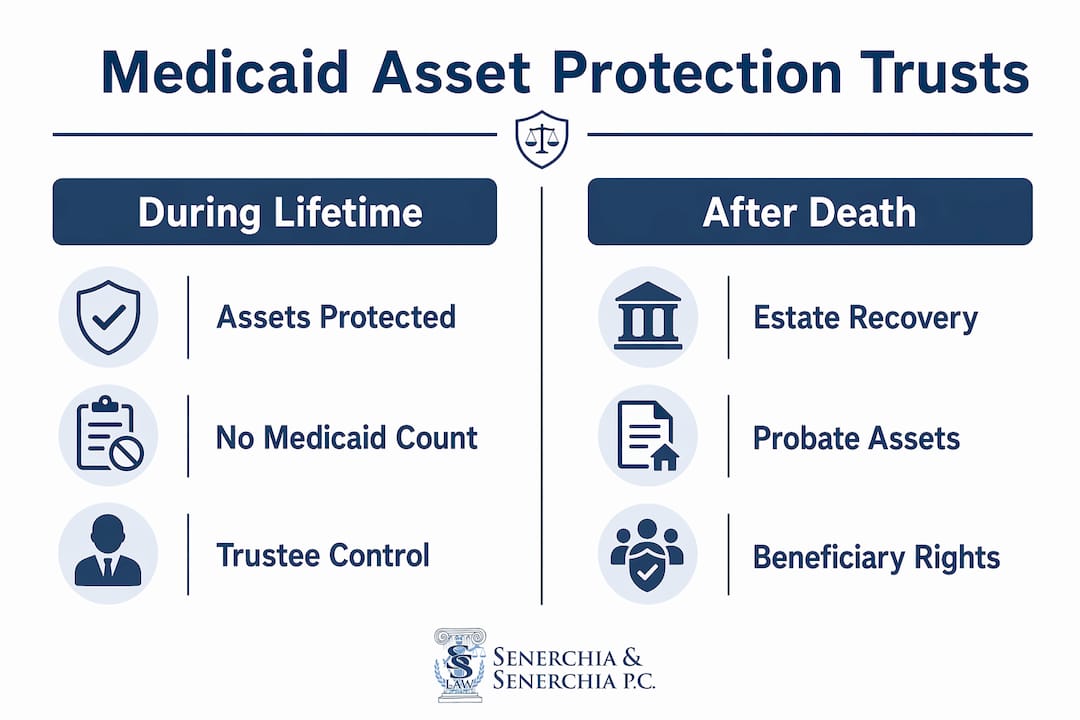
A MAPT protects your assets on two separate fronts: during your lifetime and after your death. During your lifetime, assets held in a properly funded MAPT do not count toward Medicaid’s resource limits. That means you do not have to spend them down on nursing home care before Medicaid steps in to help.
After your death, the protection continues. Rhode Island applies estate recovery only to probate assets, meaning the state can only seek reimbursement from assets that pass through your probate estate. Assets held in an irrevocable trust bypass probate entirely. The state cannot reach them.
The table below compares how different asset-holding methods fare against Medicaid’s spend-down rules and estate recovery:
| Asset-holding method | Counts toward Medicaid limit? | Subject to estate recovery? |
|---|---|---|
| Assets in your own name | Yes | Yes, through probate |
| Assets in a revocable living trust | Yes | Yes, through probate |
| Assets in a properly funded MAPT | No | No, bypasses probate |
| Jointly owned assets (with right of survivorship) | Partially | Depends on ownership structure |
Your home deserves special attention here. The home is exempt from Medicaid’s asset limit during your lifetime if a spouse or dependent lives there. After your death, however, Medicaid can pursue recovery from your probate estate, which often includes the home. Placing your home in a MAPT before the look-back period eliminates that risk entirely.
A common misconception is that Medicaid can reach trust assets if you are a beneficiary. With an irrevocable trust structured correctly, that is not true. The key is that you must give up control of the principal. Receiving income from the trust is generally permitted, but the principal stays protected.
Pro Tip: A revocable living trust does not protect assets from Medicaid. Only an irrevocable trust structured as a MAPT achieves that result. Many families avoid probate in Rhode Island with a revocable trust but mistakenly believe they have also protected assets from Medicaid. They have not.
What are Rhode Island’s unique Medicaid rules for spousal protection?
Rhode Island uses a medically needy spend-down model for Medicaid eligibility, which sets it apart from income-cap states. In an income-cap state, applicants with income above a set threshold are automatically disqualified unless they use a Miller Trust, also called a Qualified Income Trust. Rhode Island does not require a Miller Trust because the state allows applicants to spend down excess income on medical costs to reach eligibility. This is a meaningful advantage for Rhode Island residents with higher incomes.
For married couples, Rhode Island follows federal spousal impoverishment protections. These rules prevent the healthy spouse, called the community spouse, from being left with nothing when the other enters a nursing home. Key protections include:
- Community Spouse Resource Allowance (CSRA). The community spouse keeps up to 50% of the couple’s countable assets, subject to federal minimum and maximum limits, at the time of the Medicaid application.
- Minimum Monthly Maintenance Needs Allowance (MMMNA). The community spouse is entitled to a minimum monthly income. If their own income falls short, they can receive a portion of the institutionalized spouse’s income to make up the difference.
- Spousal refusal. Rhode Island recognizes spousal refusal, which allows the community spouse to legally refuse to contribute their assets to the cost of the institutionalized spouse’s care. This is a complex legal step with real risks, including potential state action against the refusing spouse, and requires experienced elder law counsel.
A MAPT fits into this framework by protecting assets that fall outside the CSRA. If a couple has assets well above the CSRA limit, the excess would normally have to be spent down. Transferring those excess assets into a MAPT before the look-back period preserves them for the family. The community spouse can still benefit from trust income in some structures, adding another layer of financial security.
Rhode Island’s spend-down model also means that income planning and asset planning work together. A well-designed MAPT, combined with proper income structuring, gives Rhode Island families more flexibility than residents of income-cap states typically have.
How do you establish and fund a MAPT in Rhode Island?
Creating a valid MAPT requires more than signing a document. The trust must be properly drafted, funded, and maintained to achieve its protective purpose. Working with a qualified Rhode Island elder law attorney is not optional here. A poorly drafted trust can fail entirely, leaving your assets exposed.
The process follows these steps:
- Consult an elder law attorney. Discuss your assets, health, family situation, and goals. A qualified attorney will assess whether a MAPT is the right tool and how to structure it under current Rhode Island law.
- Draft the irrevocable trust document. The attorney prepares a trust tailored to your circumstances, naming a trustee (often an adult child or trusted family member) and your beneficiaries.
- Sign and notarize the trust. Rhode Island requires proper legal execution. The document must meet all formal requirements to be valid.
- Fund the trust. Transfer your assets into the trust. For real estate, this means recording a new deed. For financial accounts, it means retitling them in the trust’s name. An unfunded trust protects nothing.
- Maintain records. Keep documentation of all transfers, trust activity, and trustee decisions. Medicaid will review these records during the application process.
Common assets placed in MAPTs include the family home, investment accounts, bank accounts, and rental properties. Retirement accounts like IRAs generally cannot go into a MAPT without triggering tax consequences, so those require separate planning.
Funding pitfalls are real and costly. Transferring assets to the trust but failing to record the deed, retitle accounts, or update beneficiary designations leaves those assets outside the trust’s protection. Medicaid will count them.

Pro Tip: Do not name yourself as trustee of your own MAPT. Doing so can give Medicaid grounds to argue you retained control, which could invalidate the trust’s protective effect. Name a trusted adult child or a professional trustee instead.
Timing is everything. The Rhode Island estate planning process for a MAPT works best when started years before any anticipated need for long-term care. Once the 60-month clock starts, you simply wait. The earlier you act, the more assets you can protect.
How Senerchia & Senerchia Law helps Rhode Island families protect their assets
Medicaid planning is one of the most time-sensitive areas of estate planning in Rhode Island. A missed deadline or a poorly structured trust can cost a family hundreds of thousands of dollars. Senerchia & Senerchia Law works with Rhode Island families to draft, fund, and maintain Medicaid Asset Protection Trusts that hold up under scrutiny. The firm understands Rhode Island’s specific Medicaid rules, the Department of Human Services’ review process, and the legal formalities that make a MAPT effective. If you are ready to protect your home and savings from nursing home costs and estate recovery, the attorneys at Senerchia & Senerchia Law provide clear, practical guidance at every step. Learn more about how the firm approaches asset protection for families and what documents your plan should include.
Key takeaways
A Medicaid Asset Protection Trust, properly funded before Rhode Island’s 60-month look-back period, removes assets from Medicaid’s countable estate and shields them from state recovery after death.
| Point | Details |
|---|---|
| MAPT removes assets from Medicaid count | Irrevocable trust status legally excludes assets from Medicaid’s resource calculation. |
| 60-month look-back is the critical deadline | Transfers made within five years of applying trigger penalty periods that delay benefits. |
| Estate recovery targets probate only | Assets in a properly funded MAPT bypass probate and cannot be claimed by Rhode Island Medicaid. |
| Rhode Island has no Miller Trust requirement | The state’s spend-down model lets applicants qualify without a Qualified Income Trust. |
| Spousal protections add planning flexibility | The CSRA and income allowances protect the community spouse; a MAPT shields assets above those limits. |
FAQ
What is a Medicaid Asset Protection Trust?
A Medicaid Asset Protection Trust is an irrevocable trust that permanently removes assets from your countable estate, protecting them from Medicaid’s spend-down rules and from state estate recovery after your death.
How long before applying for Medicaid should I set up a MAPT in Rhode Island?
You should fund a MAPT at least 60 months before applying for long-term care Medicaid in Rhode Island. Transfers made within that five-year window trigger penalty periods that delay your benefits.
Can Rhode Island Medicaid take my home after I die?
Rhode Island Medicaid can recover from your probate estate after your death, which often includes your home. Placing your home in a properly funded MAPT before the look-back period removes it from your probate estate and protects it from recovery.
Does Rhode Island require a Miller Trust for Medicaid eligibility?
Rhode Island does not require a Miller Trust. The state uses a medically needy spend-down model, allowing applicants to reduce excess income through medical costs rather than routing it through a Qualified Income Trust.
Can my spouse keep assets if I apply for Medicaid in Rhode Island?
Yes. Rhode Island follows federal spousal impoverishment rules, allowing the community spouse to keep up to 50% of the couple’s countable assets within federal limits, plus a minimum monthly income allowance to prevent financial hardship.