


TL;DR:
- Rhode Island requires a licensed attorney to supervise every step of residential real estate closings. Buyers must understand state-specific timelines, disclosures, and costs to ensure a smooth process. Preparation and attorney involvement are essential for a successful and timely closing.
Rhode Island’s residential real estate closing process is defined by one non-negotiable requirement: a licensed attorney must supervise every step. Unlike most states where title companies handle closings independently, Rhode Island mandates attorney involvement by law, meaning your closing is a legal proceeding, not just a paperwork exchange. To successfully navigate residential real estate closing in Rhode Island, you need to understand the state’s specific timelines, disclosure rules, cost structure, and the central role your attorney plays from contract to deed recording. This guide walks you through each phase so you close with confidence, not surprises.
What documents and prerequisites do you need before closing in Rhode Island?
The Purchase and Sale agreement, commonly called the P&S, is the foundation of every Rhode Island residential closing. Your attorney drafts or reviews this contract before you sign it. Skipping attorney review at this stage is one of the most expensive mistakes buyers make.

Rhode Island law requires sellers to disclose structural, environmental, and tax conditions before a sale proceeds. That includes the condition of the roof, heating, electrical, and plumbing systems, plus lead paint, radon, mold, association fees, and even the presence of burial grounds on the property. These disclosures are not optional, and buyers should read every line carefully.
Your lender must provide a Loan Estimate within three business days of your mortgage application. That document gives you an early look at your projected closing costs so you can plan your finances before you reach the closing table.
Earnest money goes into escrow, typically managed by one of the attorneys in the transaction. You will also need a municipal lien certificate, which confirms no outstanding taxes or assessments are owed on the property. Your attorney requests this from the city or town, and it takes time, so do not wait.
- Signed Purchase and Sale agreement reviewed by your attorney
- Mortgage pre-approval letter and Loan Estimate from your lender
- Completed seller disclosure forms covering structural, environmental, and tax conditions
- Earnest money deposited into attorney-managed escrow
- Municipal lien certificate requested from the local municipality
- Final water meter reading scheduled in advance with your attorney
Pro Tip: Ask your attorney to request the municipal lien certificate and schedule the water meter reading on the same day you sign the P&S. Both items have lead times that can delay your closing if you wait.
What does the Rhode Island residential closing timeline look like?
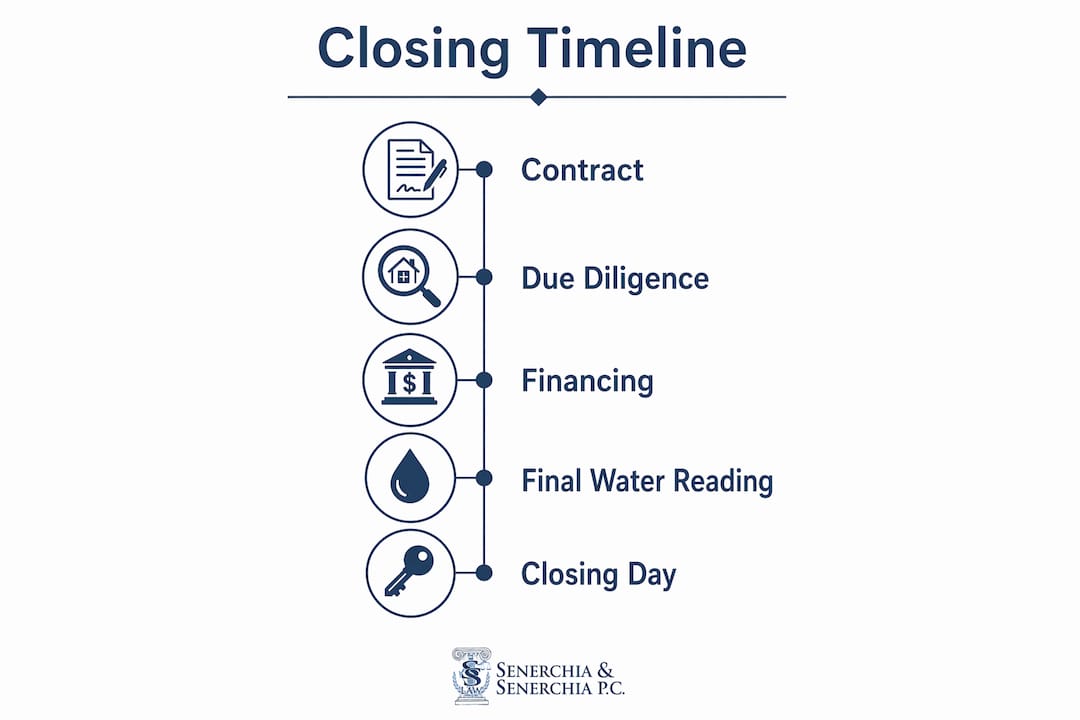
The timeline for a Rhode Island closing depends almost entirely on how you are financing the purchase. Financed transactions typically take 45–60 days from accepted offer to closing. Cash purchases can close in as little as two to three weeks. That gap exists because lenders require appraisals, underwriting, and final loan approval before they release funds.
Here is how a standard financed closing unfolds:
- Days 1–5: Offer accepted, P&S drafted and signed by both parties with attorney oversight.
- Days 5–14: Home inspection completed; buyer requests repairs or credits based on findings.
- Days 10–20: Mortgage application submitted; Loan Estimate received within three business days.
- Days 15–30: Attorney orders title examination and municipal lien certificate; appraisal scheduled by lender.
- Days 30–45: Underwriting review; attorney prepares deed and closing documents.
- Days 45–55: Final water meter reading coordinated by attorney; Closing Disclosure issued at least three business days before closing.
- Days 55–60: Closing day. Attorney supervises document execution, collects funds, and records the deed with the municipality.
| Phase | Key Task | Who Leads |
|---|---|---|
| Contract | P&S drafting and signing | Attorney |
| Due diligence | Inspections and disclosures | Buyer and seller |
| Financing | Appraisal and underwriting | Lender |
| Title work | Title exam and lien certificate | Attorney |
| Closing day | Document execution and deed recording | Attorney |
Pro Tip: Request your Closing Disclosure the moment it is available. You have three business days to review it before signing. Use that time to compare it line by line against your Loan Estimate.
Rhode Island’s coordination between attorneys, title companies, and municipalities is more layered than buyers expect. A missed step in any one area can push your closing date back by days or even weeks.
How much do closing costs run in Rhode Island?
Buyers in Rhode Island pay 2% to 5% of the purchase price in closing costs. On a median home priced at $425,000, that translates to roughly $10,625 to $17,000 out of pocket at closing. That is a wide range, and knowing what drives costs up or down puts you in a better position to negotiate.
The main cost categories include:
- Lender fees: Origination charges, points, and processing fees vary by lender.
- Title insurance: Protects both the lender and, optionally, the buyer against title defects.
- Appraisal: Required by most lenders; typically $400–$600 for a standard residential property.
- Recording fees: Paid to the municipality when the deed is recorded.
- Property taxes: Prorated at closing based on the closing date.
- State conveyance tax: Rhode Island charges $2.30 per $500 of sale price, typically paid by the seller but negotiable in the contract.
- Attorney fees: Attorney fees range from approximately $700 to $1,500 per side, depending on transaction complexity.
Coastal properties add another layer. Flood insurance requirements and lead paint inspections for older homes can increase your total cost meaningfully. A waterfront property in Narragansett or Westerly may carry flood insurance premiums that dwarf every other line item on your closing disclosure.
Closing costs are negotiable. You can ask the seller to cover a portion of your costs as a concession, and you can shop attorney and title fees before committing. Getting two or three estimates from attorneys is standard practice, not an insult. Understanding what factors determine closing expenses before you make an offer gives you real leverage at the negotiating table.
What mistakes should you avoid when closing on Rhode Island residential property?
The most costly mistake buyers make is underestimating the attorney’s role. Using a non-attorney closing agent in Rhode Island constitutes unauthorized practice of law and exposes you to serious legal risk. Your attorney must certify the title and personally supervise the closing. There is no workaround.
Scheduling the final water meter reading is a critical and frequently overlooked step. It must be coordinated by the buyer’s closing attorney ahead of closing day. Missing it causes holdbacks or recording delays that push your closing date back.
Other common pitfalls include:
- Ignoring seller disclosures instead of reviewing them with your attorney before the inspection period ends.
- Failing to compare Loan Estimates from multiple lenders, which can cost you thousands in unnecessary fees.
- Assuming a cash closing requires no legal oversight. Cash buyers still need title examination and deed preparation by a licensed attorney.
- Overlooking environmental hazard inspections, particularly for older homes where lead paint and radon are real concerns.
- Not negotiating seller concessions early. Once you are past the P&S signing, your leverage drops significantly.
Pro Tip: Build a real estate closing checklist specific to Rhode Island and share it with your attorney at your first meeting. It keeps both of you accountable to the same timeline.
Key Takeaways
Successfully closing on Rhode Island residential real estate requires attorney supervision, early preparation, and a clear understanding of state-specific costs, timelines, and disclosure obligations.
| Point | Details |
|---|---|
| Attorney supervision is mandatory | Rhode Island law requires a licensed attorney to certify title and supervise every closing. |
| Timeline varies by financing | Financed closings take 45–60 days; cash closings can close in 2–3 weeks. |
| Closing costs range widely | Expect to pay 2%–5% of the purchase price, or $10,625–$17,000 on a $425,000 home. |
| Water meter reading causes delays | Schedule this municipality-specific step early through your attorney to avoid holdbacks. |
| Costs are negotiable | Seller concessions, attorney fees, and title charges can all be negotiated before closing. |
What I’ve learned from years of Rhode Island closings
Most buyers walk into their first Rhode Island closing thinking it is similar to what they have heard from friends in other states. It is not. The attorney-mandatory requirement changes the entire dynamic. Your attorney is not a formality. They are the person who examines your title, catches encumbrances before they become your problem, and makes sure the deed gets recorded correctly the same day.
The clients who close smoothly are the ones who treat the attorney relationship as a partnership from day one, not a service they hire at the last minute. I have seen cash buyers try to rush a two-week closing only to hit a wall because the municipal lien certificate was not ordered in time. I have seen financed buyers lose their rate lock because an inspection dispute dragged into week seven.
Rhode Island’s process rewards preparation. The buyers who read their seller disclosures carefully, compare lender estimates, and ask their attorney about the water meter reading in week one are the ones who close on time. The ones who wait for their attorney to bring things up often find themselves scrambling.
My honest advice: hire an attorney who handles Rhode Island residential closings regularly, not occasionally. The nuances of local municipal requirements, title standards, and disclosure law are not things you want someone learning on your transaction.
— Anthony
How Senerchia & Senerchia Law guides you through the closing process
Buying a home in Rhode Island involves more legal coordination than most buyers expect. Senerchia & Senerchia Law provides the full range of real estate legal services Rhode Island buyers and investors need, from Purchase and Sale agreement review and title examination to closing supervision and deed recording. The firm works with first-time buyers, seasoned investors, and families managing complex transactions, always with the same attention to detail and clear communication that makes a difference when timelines are tight. If your transaction involves estate considerations, the team also handles probate and property transfers so nothing falls through the cracks. Contact Senerchia & Senerchia Law to make sure your Rhode Island closing is handled correctly from contract to keys.
FAQ
Is Rhode Island an attorney-mandatory closing state?
Yes. Rhode Island requires a licensed attorney to certify the title and supervise the closing. Using a non-attorney closing agent is considered unauthorized practice of law.
How long does a residential closing take in Rhode Island?
Financed closings typically take 45–60 days. Cash purchases can close in as little as two to three weeks, depending on how quickly title work and municipal requirements are completed.
What closing costs should buyers expect in Rhode Island?
Buyers pay 2%–5% of the purchase price in closing costs. On a $425,000 home, that equals roughly $10,625 to $17,000, covering lender fees, title insurance, attorney fees, and state conveyance tax.
What is the final water meter reading and why does it matter?
The final water meter reading is a municipality-specific requirement that must be completed before the deed is recorded. Missing it delays closing, so buyers should ask their attorney to schedule it well in advance.
Can buyers negotiate closing costs in Rhode Island?
Yes. Buyers can negotiate seller concessions, shop attorney and title fees, and request credits for repairs identified during inspection. Negotiating before the P&S is signed gives you the most leverage.