


TL;DR:
- Probate avoidance involves structuring estates to transfer assets directly to heirs without court supervision, especially important in Rhode Island due to its 39 municipal probate courts. Using tools like revocable living trusts, joint tenancy, and beneficiary designations can help families bypass probate, but proper funding and asset retitling are essential. Without careful planning, common issues such as unfunded trusts or outdated designations can lead to delays, added costs, and unwanted court involvement.
Probate avoidance is the practice of structuring your estate so assets transfer directly to heirs without court supervision. Knowing how to avoid probate in Rhode Island matters more than in most states because Rhode Island operates 39 separate municipal probate courts, each with its own local procedures and potential for delay. The good news is that tools like revocable living trusts, joint tenancy, and beneficiary designations give Rhode Island families real, proven ways to keep their estates out of court. This guide walks you through each option clearly, so you can make confident decisions for your family.
How to avoid probate in Rhode Island: what you need to know first
Probate is a public, court-supervised process that involves asset inventories, creditor notices, and a final accounting before anything passes to your heirs. Rhode Island law also requires a six-month waiting period for creditors to file claims, which extends the timeline considerably. That delay, combined with the cost of legal fees and the loss of privacy, is why so many families prioritize probate-free estate planning.

Rhode Island also imposes an estate tax on estates valued over $1,838,056, with rates reaching up to 16%. Real estate carries an automatic lien until that tax is resolved. These two facts together mean that larger estates face both probate court and a tax obligation that can tie up property for months.
The standard industry term for what most people call “skipping probate” is probate avoidance planning. The primary tools are revocable living trusts, joint ownership arrangements, and payable-on-death (POD) or transfer-on-death (TOD) designations on financial accounts. Each tool works differently, and Rhode Island has one important limitation that shapes the entire strategy: the state does not recognize TOD deeds for real estate.
What triggers probate in Rhode Island?
Any asset titled solely in a deceased person’s name triggers probate. That includes bank accounts, investment accounts, vehicles, and most importantly, real estate. If your name alone appears on a deed, that property must pass through a Rhode Island probate court before your heirs can take ownership.
Rhode Island does offer a simplified small estate procedure, but its scope is narrow. It applies only to estates below $15,000 in personal property, excludes real estate entirely, and requires a 30-day waiting period before it can be used. For most Rhode Island families who own a home, this exception offers no practical relief.
Rhode Island inheritance laws also include a 120-hour survivorship rule. An heir must survive the decedent by 120 hours to legally inherit. If they do not, the estate is distributed as if that heir had died first. This rule can create unexpected probate complications when multiple family members are involved in an accident or illness at the same time.
Here is a quick summary of what does and does not trigger probate in Rhode Island:
- Assets that trigger probate: Real estate titled in your name alone, solely owned bank accounts with no POD designation, vehicles, and personal property above $15,000.
- Assets that bypass probate: Jointly owned property with right of survivorship, accounts with valid POD or TOD designations, assets held inside a funded revocable living trust, and life insurance with a named beneficiary.
- The small estate exception: Available only for personal property under $15,000, with no real estate and a mandatory 30-day wait.
- The 120-hour rule: Affects succession planning and can redirect assets unexpectedly if heirs do not survive long enough.
Understanding these triggers is the foundation of any solid estate plan. Once you know what sends assets to court, you can take deliberate steps to keep them out.
How does a revocable living trust help you skip probate?
A revocable living trust is a legal arrangement where you transfer ownership of your assets into a trust during your lifetime. Think of it as a container that holds your assets. You remain in control as the trustee while you are alive, and a successor trustee you name takes over after your death to distribute assets directly to your beneficiaries, with no court involvement.
Because the trust owns the assets rather than you as an individual, those assets do not enter probate when you die. This is especially important in Rhode Island because TOD deeds for real estate are not recognized here. In many other states, homeowners can simply file a transfer-on-death deed to pass real estate outside of probate. Rhode Island families do not have that option. A revocable living trust is the primary and most reliable way to keep your home out of a probate court.
The trust also keeps your estate details private. Probate is a public process that exposes your asset inventory and family financial matters to anyone who looks. A trust distributes assets privately, according to your written terms, without any public record.
Key benefits of a revocable living trust in Rhode Island include:
- Covers real estate: Your home transfers to heirs without a probate filing.
- Privacy: Distribution terms stay out of the public record.
- Speed: A successor trustee can act within days rather than months.
- Flexibility: You can amend or revoke the trust at any time while you are alive.
- Continuity: If you become incapacitated, your successor trustee manages assets without court intervention.
Pro Tip: Creating a trust document is only half the job. You must also retitle your assets into the trust’s name. A trust that holds no assets provides no probate protection at all. This step, called “funding the trust,” is where many DIY estate plans fail.
What other Rhode Island probate alternatives are available?
Beyond trusts, Rhode Island families have several additional tools for keeping assets out of court. Each one works well for specific asset types, and most work best when combined with a trust rather than used alone.
| Tool | Best for | Cost | Limitation in Rhode Island |
|---|---|---|---|
| Joint tenancy with right of survivorship | Real estate, bank accounts | Low | Surviving owner inherits everything; no control over ultimate beneficiary |
| Tenancy by the entirety | Married couples, real estate | Low | Only available to spouses; ends at divorce |
| POD/TOD designations | Bank accounts, investment accounts | Free | Can override your will if not updated |
| Life estate deed | Real estate | Moderate | Limits your ability to sell or refinance without beneficiary consent |
| Revocable living trust | All asset types, including real estate | Higher upfront | Must be properly funded to work |
Joint tenancy with right of survivorship means that when one owner dies, the surviving owner automatically inherits the full asset. For married couples, tenancy by the entirety provides the same result with added creditor protection. Both arrangements work well for a primary residence when both spouses are alive and the goal is simple spousal transfer.
POD and TOD designations are free to set up at your bank or brokerage. They work by naming a beneficiary who receives the account directly after your death. The critical risk is that these designations can unintentionally override your will if you forget to update them after a divorce, remarriage, or the death of a named beneficiary. A designation made 20 years ago still controls the account today, regardless of what your current will says.
Life estate deeds are a middle-ground option for real estate. You retain the right to live in and use the property during your lifetime, and ownership transfers automatically to the named remainderman at your death. The tradeoff is that selling or refinancing requires the remainderman’s consent, which can create complications.
Step-by-step guide to implementing probate avoidance in Rhode Island
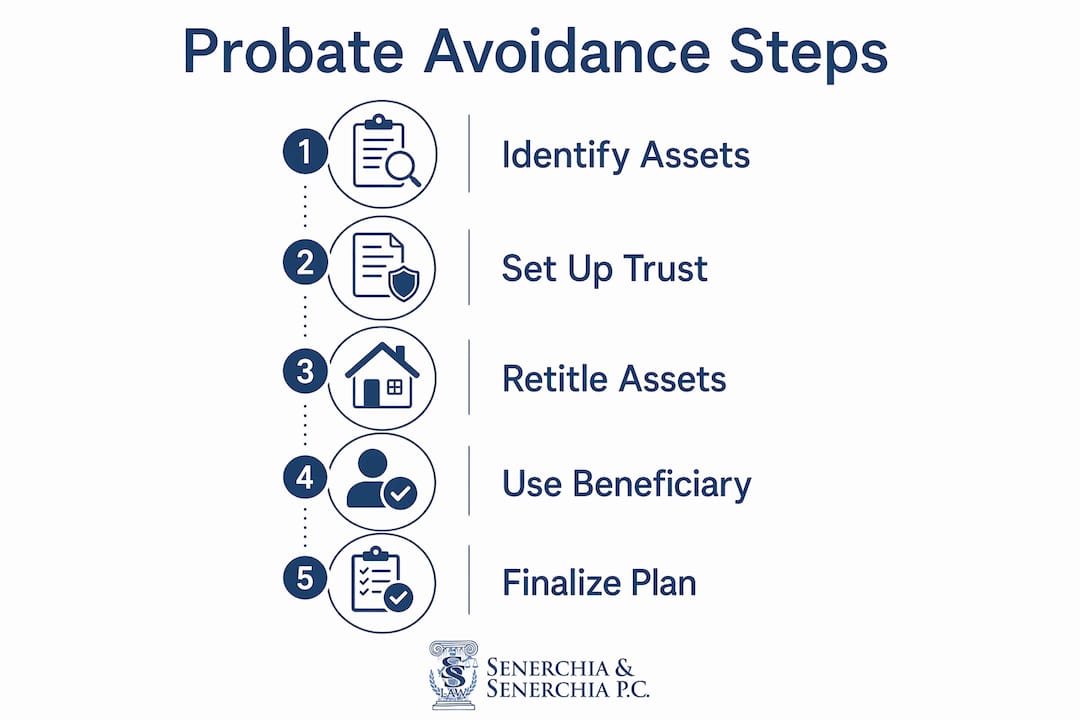
Putting a probate-free estate plan in place requires more than signing documents. Each step below builds on the last, and skipping any one of them can leave gaps that send assets back into court.
- Draft a revocable living trust. Work with a Rhode Island estate planning attorney to create a trust document that names you as trustee, designates a successor trustee, and specifies how assets are distributed. Generic online templates often miss Rhode Island-specific requirements.
- Fund the trust with real estate. Retitle your home and any other real property into the trust’s name by recording a new deed. This is the single most important step for Rhode Island homeowners, given the state’s lack of TOD deeds. Review how to set up a living trust for detailed guidance on this process.
- Transfer financial accounts. Contact your bank and brokerage to retitle accounts into the trust or add the trust as a beneficiary. Without proper asset titling, the trust offers no probate protection for those accounts.
- Update beneficiary designations. Review all life insurance policies, retirement accounts (IRAs, 401(k)s), and annuities. Name specific individuals or your trust as beneficiary. Remove outdated names and confirm that contingent beneficiaries are current.
- Review joint ownership arrangements. Confirm that jointly held property is titled as joint tenancy with right of survivorship or, for married couples, tenancy by the entirety. A deed that simply lists two names without specifying the ownership type may not carry survivorship rights.
- Keep a pour-over will as a backup. A will does not avoid probate, but a pour-over will directs any assets you forgot to transfer into the trust to flow there at death. It acts as a safety net for assets that slip through the cracks.
- Review your plan every three to five years. Life changes such as marriage, divorce, the birth of a child, or the death of a beneficiary can make your current plan outdated. Schedule periodic reviews with your attorney.
Pro Tip: If you own property in multiple states, you may need a separate trust or ancillary probate proceeding in each state where real estate is titled. A Rhode Island attorney can help you structure ownership to avoid that complication before it becomes a problem.
Common challenges when avoiding probate in Rhode Island
Even well-intentioned estate plans can fall short. These are the most common problems Rhode Island families encounter, and what you can do about each one.
- Unfunded trusts: Creating a trust document without retitling assets is the most frequent mistake. The trust exists on paper but holds nothing, so everything still goes through probate. Always confirm that deeds and account titles reflect the trust’s name.
- Outdated beneficiary designations: A POD designation naming an ex-spouse or a deceased parent still controls the account. Review designations after every major life event and confirm them with your financial institutions directly.
- Misunderstood joint ownership: Adding an adult child to a deed as a joint owner may seem like a simple solution, but it gives that child an immediate ownership interest. Their creditors can potentially reach the property, and their consent is required for any sale.
- Fragmented probate courts: Rhode Island’s 39 municipal probate courts each operate with local rules and varying timelines. If an asset slips into probate, the process can be unpredictable depending on the municipality. A trust sidesteps all 39 of them.
- Estate tax liens on real estate: For estates above the $1,838,056 threshold, Rhode Island places an automatic lien on real estate until the estate tax is paid. Even a well-funded trust does not eliminate this obligation. Proper tax planning is a separate but related step.
- Relying on a will alone: A will is a probate document. It tells the court how to distribute your assets, but it does not keep assets out of court. Families who rely solely on a will are not avoiding probate. They are directing it.
If you are unsure whether your current plan covers all your assets, a review with a Rhode Island estate planning attorney can identify gaps before they become costly problems for your family.
Key takeaways
A revocable living trust is the most reliable tool for avoiding probate in Rhode Island, especially for real estate, because the state does not recognize transfer-on-death deeds.
| Point | Details |
|---|---|
| Trusts are essential for real estate | Rhode Island has no TOD deeds, making a funded revocable living trust the only reliable way to pass real property outside of probate. |
| Small estate exception is very limited | The simplified procedure applies only to personal property under $15,000 and cannot be used for real estate. |
| Beneficiary designations require maintenance | POD and TOD designations override your will and must be reviewed after every major life change. |
| Funding the trust is non-negotiable | A trust document without retitled assets provides zero probate protection; every account and deed must reflect the trust’s ownership. |
| Rhode Island’s 39 courts add complexity | Fragmented municipal probate courts create unpredictable delays; a properly funded trust bypasses all of them. |
Plan your Rhode Island estate with Senerchia & Senerchia Law
Avoiding probate takes more than good intentions. It takes correctly drafted documents, properly titled assets, and a plan that accounts for Rhode Island’s specific laws. Senerchia & Senerchia Law helps Rhode Island families build estate plans that actually work, from drafting revocable living trusts and retitling real estate to updating beneficiary designations and reviewing existing plans for gaps. Whether you are starting from scratch or updating a plan you made years ago, the attorneys at Senerchia & Senerchia Law provide clear, personalized guidance every step of the way. Explore the estate planning documents attorneys prepare for Rhode Island families, or learn more about comprehensive estate planning services tailored to your goals.
FAQ
What is the easiest way to avoid probate in Rhode Island?
A revocable living trust is the most complete solution because it covers all asset types, including real estate, which cannot be transferred via TOD deed in Rhode Island. Pairing a trust with updated beneficiary designations on financial accounts covers most estates fully.
Does a will avoid probate in Rhode Island?
No. A will is a probate document that directs the court on how to distribute your assets. It does not keep assets out of court. To learn what happens without any plan in place, see dying without a will in Rhode Island.
How long does probate take in Rhode Island?
Rhode Island probate requires a six-month waiting period for creditors alone, and the full process often takes longer depending on the complexity of the estate and the specific municipal court handling the case.
Can joint ownership replace a trust in Rhode Island?
Joint ownership works well for a primary residence between spouses, but it does not cover all assets and creates risks such as unintended creditor exposure. A trust provides broader protection and more control over who ultimately inherits.
Does Rhode Island have an estate tax I should plan for?
Yes. Rhode Island imposes an estate tax on estates above $1,838,056, with rates up to 16%. Real estate carries an automatic lien until the tax is resolved, which is a separate planning consideration beyond probate avoidance alone.