


TL;DR:
- Probate in Rhode Island is a court-supervised process that manages a deceased person’s estate, pays debts, and transfers assets to heirs. The state operates 39 independent municipal probate courts, making the process highly decentralized and location-specific.
Probate in Rhode Island is the court-supervised legal process that administers a deceased person’s estate, pays outstanding debts, and transfers assets to heirs. Understanding how does probate work in Rhode Island matters because the state runs one of the most decentralized systems in the country. Unlike most states that use county courts, Rhode Island operates 39 independent municipal probate courts, one for each city and town. That structure means the rules, fees, and schedules you face depend entirely on where your loved one lived. This guide walks you through every stage of the Rhode Island probate process so you know exactly what to expect.
How does probate work in rhode island step by step?
Estate administration in Rhode Island formally begins when someone files a petition with the probate court in the city or town where the deceased person lived. That filing location is not a county court or a state court. It is the municipal probate court of the decedent’s last residence. If your loved one lived in Warwick, you file in Warwick. If they lived in Newport, you file in Newport.
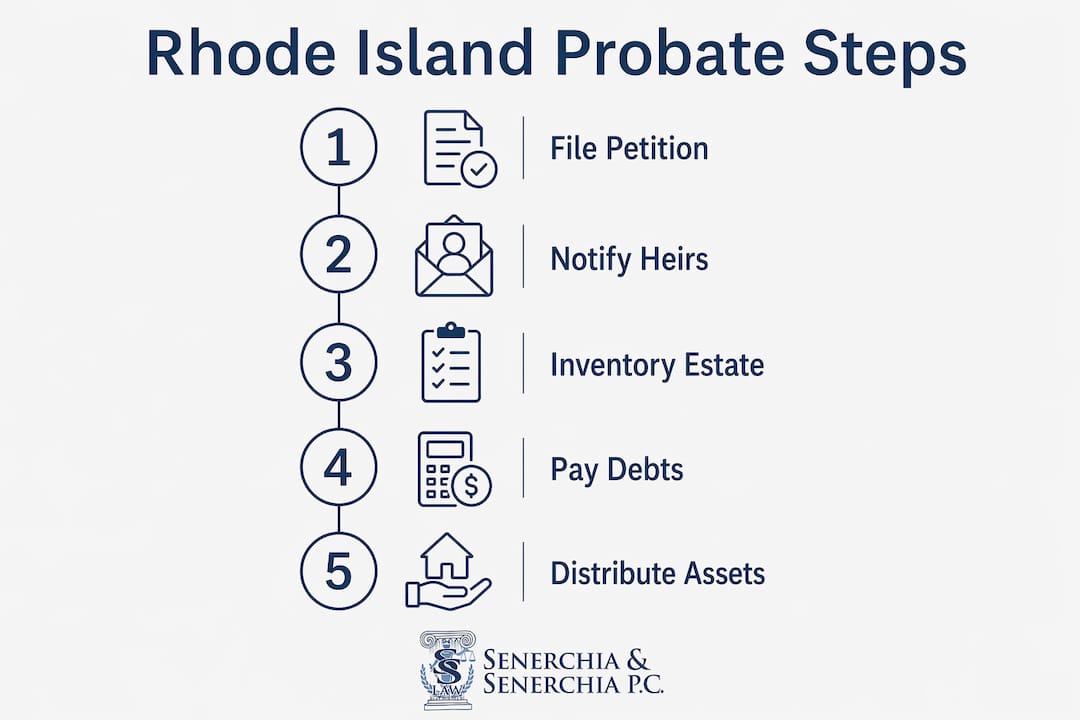
The full Rhode Island probate process follows these core steps:
- File the petition. Submit the original will and death certificate to the local probate court. If no will exists, file a petition for intestate administration. Intestate means the person died without a valid will, and Rhode Island’s inheritance statutes determine who receives the estate.
- Appoint an executor or administrator. The court reviews the petition and appoints the named executor from the will, or an administrator if no will exists. The court then issues Letters Testamentary or Letters of Administration, which give that person legal authority to act on behalf of the estate.
- Publish notice to creditors. Rhode Island law requires notice published in a local newspaper for three consecutive weeks. Creditors then have a six-month window from the first published notice to file claims against the estate. That six-month period is the primary reason most Rhode Island probate cases take at least that long to close.
- File an inventory of assets. The executor must file an asset inventory within three months of appointment. This inventory documents the fair market value of all personal property and real estate, and real property typically requires a formal appraisal.
- Pay debts and taxes in priority order. Rhode Island law sets a strict payment hierarchy. Funeral expenses come first, followed by estate administration costs, then taxes, then general creditors. Executors who deviate from this order risk personal liability for improperly paid claims.
- Distribute remaining assets. Once debts and taxes are settled, the executor distributes what remains to beneficiaries according to the will or, if no will exists, according to Rhode Island’s intestacy laws.
Pro Tip: Request certified copies of the Letters Testamentary the same day the court issues them. Banks, title companies, and financial institutions all require original certified copies before releasing assets, and ordering them later adds weeks to your timeline.
What is rhode island’s small estate summary probate?

Not every estate requires full formal administration. Rhode Island offers a simplified path called summary probate for qualifying small estates. Summary probate applies only when personal property is valued at $15,000 or less and the estate contains no real estate at all. If the deceased owned a home or any other real property, the estate does not qualify regardless of its total value.
The summary probate process works like this:
- An interested party files an affidavit with the local probate court at least 30 days after the date of death.
- The affidavit identifies the decedent, lists the personal property, and names the rightful heirs.
- The court reviews the filing and, if approved, authorizes distribution without a full administration proceeding.
- No executor appointment, no creditor publication period, and no formal inventory are required.
The practical difference between summary probate and full administration is significant. Full administration can take six months to two years. Summary probate can resolve in a matter of weeks. The trade-off is strict eligibility. One piece of real estate, or personal property worth more than $15,000, and you are back to the full process.
Pro Tip: If your loved one owned a vehicle but no real estate, check whether the vehicle’s value alone pushes the estate above $15,000. A car worth $18,000 disqualifies the estate from summary probate even if it is the only asset.
What are the costs and timelines for rhode island probate?
Probate costs in Rhode Island are predictable in structure but variable in total. Filing fees are calculated at 1% of the personal property value of the estate, with a minimum fee of $30 and a maximum cap of $1,500. A $200,000 personal property estate, for example, generates a $1,500 filing fee because it hits the cap.
Beyond filing fees, you should budget for additional costs:
| Cost Item | Typical Range |
|---|---|
| Filing fee | $30–$1,500 (1% of personal property) |
| Creditor notice publication | $150–$300 |
| Executor compensation | Court-determined, no fixed schedule |
| Attorney fees | Varies by complexity |
| Real estate appraisal | $300–$600 per property |
“Executor fees in Rhode Island have no statutory schedule. The court determines reasonable compensation based on the size and complexity of the estate. In practice, fees often range from 2% to 4% of the estate’s gross value, but contested or complex estates can push that figure higher.”
Simple estates typically close in 6–9 months. Complex or contested estates routinely take one to two years or longer. The six-month creditor notice period alone sets a hard floor on how fast any estate can close. Disputes among heirs, missing assets, or unresolved tax issues all extend that timeline further.
How do rhode island’s 39 probate courts differ?
Rhode Island’s decentralized probate system is unlike anything most people expect. Each of the state’s 39 municipalities operates its own probate court with its own filing fees, bond requirements, hearing schedules, and local forms. What works in Cranston may not work in Bristol.
Here is what varies from court to court:
- Hearing frequency. Providence Probate Court operates full-time with regular hearing dates. Many smaller towns hold probate sessions only once or twice a month, which can delay approvals by weeks.
- Local forms. Some courts require their own petition forms rather than generic state templates. Filing the wrong form means starting over.
- Bond requirements. Courts have discretion over whether to require a surety bond from the executor. Understanding surety bond requirements in your specific municipality can save you time and unexpected costs.
- Filing deadlines. Local rules govern how quickly certain documents must be filed after appointment.
The lack of uniformity across Rhode Island’s municipal courts makes early contact with the local probate clerk one of the most important steps an executor can take. Call the clerk’s office before you file anything. Ask about required forms, current hearing dates, and any local rules that apply to your case.
Pro Tip: Ask the probate clerk for a local checklist on your first call. Many courts have informal checklists they share with executors that are not posted online. That single document can prevent multiple trips back to the courthouse.
Estate tax, real estate liens, and contested wills in rhode island
Rhode Island imposes a state estate tax on estates with a gross value above $1,838,056 in 2026. That threshold is lower than the federal estate tax exemption, which means some Rhode Island estates owe state tax even when no federal tax is due.
| Factor | Rhode Island Rule |
|---|---|
| Estate tax threshold (2026) | $1,838,056 gross estate value |
| Form required | Form RI-706 |
| Real estate lien | Attaches automatically at death |
| Lien release | Requires filing Form RI-706 |
| Will contest penalty | Loss of inheritance under in terrorem clause |
The real estate lien issue catches many families off guard. A lien attaches automatically to any real property in a Rhode Island estate at the moment of death. That lien prevents the property from being sold or transferred until it is formally released. Filing Form RI-706 is the standard mechanism for releasing that lien, and it is often required even when the estate falls below the tax threshold. You can read more about real property transfers through probate to understand how this process works in practice.
Will contests are another area where Rhode Island law takes a firm stance. Rhode Island courts enforce in terrorem clauses strictly. An in terrorem clause, sometimes called a no-contest clause, is a provision in a will that penalizes anyone who challenges it. In Rhode Island, an unsuccessful challenger can lose their entire inheritance and may be required to pay the estate’s legal defense costs. That enforcement posture significantly discourages frivolous will contests.
Executors also carry ongoing responsibilities during probate that go beyond paperwork. You must maintain insurance on real property, keep estate accounts separate from personal funds, and manage any income-producing assets until distribution. Failing to do so can expose you to personal liability.
Pro Tip: If the estate includes real estate and you are unsure whether Form RI-706 is required, file it anyway. The cost of filing is far lower than the cost of a delayed property sale caused by an unresolved lien.
Key takeaways
Rhode Island probate is a municipal-level process governed by 39 independent courts, and understanding local rules, filing fees, and timelines is the most direct path to a smooth estate settlement.
| Point | Details |
|---|---|
| Municipal court system | File in the city or town of the decedent’s residence, not a county or state court. |
| Small estate threshold | Estates with $15,000 or less in personal property and no real estate qualify for summary probate. |
| Creditor notice period | Creditors have six months from first publication to file claims, setting a floor on probate duration. |
| Estate tax and liens | A lien attaches automatically to real estate at death; filing Form RI-706 releases it. |
| Local court variation | Each of Rhode Island’s 39 probate courts has different forms, fees, and hearing schedules. |
Work with rhode island probate attorneys who know every local court
The Rhode Island probate process is manageable, but the 39-court municipal system creates real risks for families who go it alone. A missed local form, an incorrect creditor notice, or an unresolved real estate lien can delay settlement by months. Senerchia & Senerchia Law helps Rhode Island families handle every stage of estate administration with confidence, from filing the initial petition to clearing property liens and distributing assets. If you want to reduce the chance of probate complications before they arise, reviewing the estate planning documents your family needs is the right place to start. Contact Senerchia & Senerchia Law to speak with an attorney who knows your local probate court.
FAQ
What triggers probate in rhode island?
Probate is required when a deceased person owned assets solely in their own name without a designated beneficiary or joint owner. Assets held in a trust, with a named beneficiary, or in joint tenancy typically pass outside of probate.
How long does rhode island probate take?
Simple estates generally close in 6–9 months. Complex or contested estates can take one to two years or longer, largely because the six-month creditor notice period cannot be shortened.
Can you avoid probate in rhode island?
Yes. Revocable living trusts are the most effective tool for avoiding probate in Rhode Island. Rhode Island does not recognize transfer-on-death deeds for real estate, so a trust is often the best option for property owners.
What is the filing fee for rhode island probate?
Filing fees equal 1% of the personal property value of the estate, with a minimum of $30 and a maximum cap of $1,500. Additional costs include creditor notice publication, which typically runs $150–$300.
Do all rhode island estates need to file form ri-706?
Not all estates owe estate tax, but many must still file Form RI-706 to release the automatic lien that attaches to real property at death. Filing is often required even when the estate falls below the $1,838,056 tax threshold for 2026.