


TL;DR:
- Estate planning for families involves creating legal documents like wills, trusts, and guardianships to ensure assets are managed according to your wishes. It protects minors, avoids costly probate, and must be regularly updated to accommodate life changes. Proper planning provides peace of mind by securing your family’s future and respecting your preferences.
Estate planning for families is the legal process of organizing how your assets are managed, distributed, and protected so your loved ones are cared for exactly as you intend. It covers far more than writing a will. A complete family estate plan includes trusts, powers of attorney, healthcare directives, and guardianship designations that together form a legal safety net for your children and your assets. Whether you are a young parent with a growing family or navigating a blended household, understanding what estate planning involves is the first step toward genuine peace of mind.
What is estate planning for families, and what does it include?
Estate planning for families is the structured process of deciding who receives your assets, who makes decisions on your behalf if you cannot, and who cares for your children if something happens to you. The industry term is “estate plan,” and it refers to a coordinated set of legal documents rather than any single form or filing. A full estate plan typically includes trusts, powers of attorney, and healthcare directives alongside a will. Each document serves a distinct purpose, and together they address the full range of situations a family might face.

The core goal is control. Without an estate plan, state law decides who inherits your property, who raises your children, and who manages your finances during a medical crisis. Those decisions may not reflect your wishes at all. Proactive planning replaces that uncertainty with clear, legally binding instructions.
What documents does every family estate plan need?
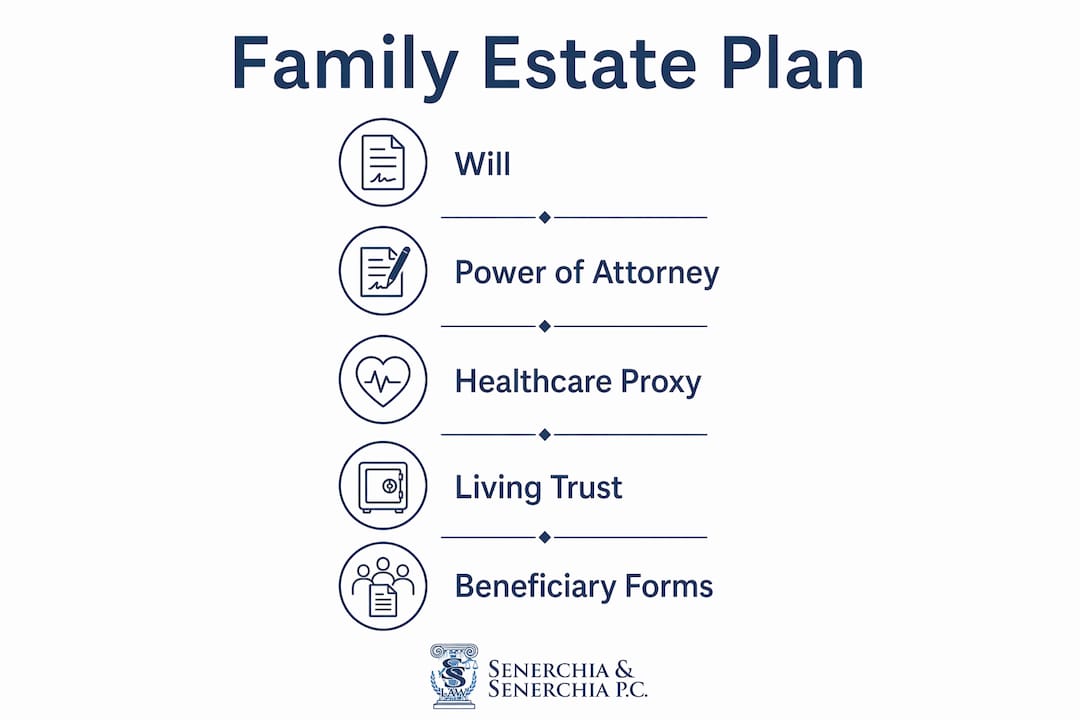
A well-built family estate plan rests on four foundational documents. Each one addresses a different vulnerability, and skipping any one of them leaves a gap that courts or state law will fill.
-
Last Will and Testament: A will directs how your property is distributed after death and, critically, names a guardian for your minor children. Guardianship designations in a will prevent a probate court from appointing someone based solely on legal priority rather than your personal preference. This is the single most important reason young parents need a will, even before accumulating significant assets.
-
Revocable Living Trust: A trust acts as a container that holds your assets during your lifetime and transfers them to beneficiaries after death without going through probate. Trusts protect assets for minor beneficiaries by allowing a professional trustee to manage investments and distributions until children reach an appropriate age. This prevents an 18-year-old from receiving a large inheritance all at once.
-
Durable Power of Attorney: This document authorizes a trusted person, called your agent, to manage your financial affairs if you become incapacitated. Without it, your family may need to petition a court for conservatorship, a process that is both expensive and time-consuming.
-
Healthcare Directive and Healthcare Proxy: A healthcare directive (also called a living will) records your medical wishes, such as preferences around life support. A healthcare proxy names someone to make medical decisions on your behalf. Both documents remove the burden of guessing from your family during an already difficult time.
Pro Tip: Name both a primary and a backup agent in every power of attorney and healthcare proxy. If your first choice is unavailable, a backup prevents the document from becoming useless at the worst possible moment.
Why does every family, including young parents, need an estate plan?
The most common misconception about estate planning is that it is only for the wealthy or the elderly. That belief leaves families exposed. Here are the four most pressing reasons every family needs a plan in place, regardless of net worth.
-
Guardianship protection. Without a will, a probate court appoints a guardian for your minor children based on state law, not your preferences. That could mean a relative you would not have chosen, or a contested proceeding that puts your children in legal limbo for months.
-
Avoiding probate delays and costs. Probate can be lengthy and costly even for families with modest assets. Legal and administrative fees consume resources that should go to your family, not the court system.
-
Reducing family conflict. Clear estate plans reduce tensions and misunderstandings between family members by removing ambiguity about who gets what and who is responsible for what.
-
Adapting to life changes. Estate planning requires updates after births, marriages, divorces, moves, or new asset acquisitions. A plan drafted before your second child was born may not protect that child at all if it is never updated.
“Without an estate plan, state laws decide guardianship and inheritance, which might not reflect your personal wishes.” — Wells Fargo
Young parents often feel that estate planning can wait until they are older or wealthier. The reality is the opposite. The earlier you establish a plan, the longer your family benefits from its protections. Read more about securing your children’s future through timely planning.
How does probate work, and how can families avoid it?
Probate is the court-supervised process of validating a will, paying debts, and distributing assets to heirs. It sounds straightforward, but the reality is far more burdensome than most families expect.
Uncontested probate takes over 12 months and costs roughly 5% of the estate’s value even in simple cases. For a family with a $400,000 home and modest savings, that translates to $20,000 or more in fees before a single dollar reaches your heirs. Probate also exposes your estate to public record, meaning anyone can look up what you owned and who received it.
| Strategy | How it avoids probate | Best suited for |
|---|---|---|
| Revocable living trust | Assets held in trust pass directly to beneficiaries | Families with real estate or multiple accounts |
| Beneficiary designations | Retirement accounts and life insurance pass outside probate | All families with 401(k), IRA, or life insurance |
| Joint tenancy with right of survivorship | Property passes automatically to the surviving owner | Married couples with shared real estate |
| Transfer-on-death deeds | Real property transfers directly without court involvement | Homeowners in states that recognize TOD deeds |
The most reliable way to keep your family out of probate court is to fund a revocable living trust properly. That means actually transferring your home, bank accounts, and investment accounts into the trust’s name. Many families create a trust but never fund it, which means those assets still go through probate. Learn more about the Rhode Island probate process and what your family can do to avoid it.
Pro Tip: Review your beneficiary designations every two to three years. A life insurance policy that still names an ex-spouse as beneficiary overrides anything your will says, because beneficiary designations are legally separate from your estate plan.
What are the special considerations for blended families and special needs children?
Not every family fits a simple structure, and estate planning must reflect that reality. Blended families, families with disabled children, and families whose circumstances have shifted all require customized planning to avoid unintended outcomes.
Blended families face a specific challenge: without careful planning, assets intended for biological children can pass entirely to a surviving spouse and then to stepchildren from a later relationship. A qualified terminable interest property trust, commonly called a QTIP trust, solves this by providing income to a surviving spouse while preserving the principal for biological children. This structure protects everyone without forcing an either/or choice.
Families with special needs children face a different risk. Leaving assets directly to a child who receives Supplemental Security Income or Medicaid can disqualify them from those benefits. Special needs trusts separate the inheritance from the child’s countable assets, preserving government benefit eligibility while still funding an enhanced quality of life. The trust can pay for education, therapy, travel, and other expenses that government programs do not cover.
Life changes demand plan updates. A divorce, a new marriage, the birth of a grandchild, or the purchase of a business all create gaps in an existing plan. Estate planning is a continuous process that evolves alongside your family’s circumstances. Treating it as a one-time task is one of the most common and costly mistakes families make. Review the most frequent estate planning mistakes families make to avoid the pitfalls that derail even well-intentioned plans.
When dividing inherited property among multiple heirs, including siblings from different relationships, the process requires careful legal guidance. Resources on dividing inherited property fairly can help families navigate these conversations before they become disputes.
How do you start and maintain a family estate plan?
Starting an estate plan feels overwhelming to most families, but the process becomes manageable when you break it into clear steps. Here is how to move from intention to a legally sound plan.
-
Identify your priorities. Decide what matters most: naming a guardian for your children, protecting a specific asset, minimizing taxes, or ensuring a disabled family member is cared for. Your priorities shape which documents you need first.
-
Consult a qualified estate planning attorney. Online will-making tools like LegalZoom can produce basic documents, but they cannot account for your state’s specific laws, your family’s unique dynamics, or the interaction between documents. A licensed attorney catches gaps that templates miss. Understanding the role of a will attorney in your planning process is a good place to start.
-
Fund your trust. If your attorney creates a revocable living trust, transfer your home, bank accounts, and investment accounts into the trust’s name. An unfunded trust provides no probate protection whatsoever.
-
Update beneficiary designations. Confirm that your life insurance, 401(k), IRA, and any transfer-on-death accounts name the correct beneficiaries and align with your overall plan.
-
Schedule periodic reviews. Revisit your plan every three to five years, or immediately after any major life event. Marriage, divorce, the birth of a child, a significant inheritance, or a move to a new state all warrant a review.
Pro Tip: Store your estate planning documents in a fireproof safe and tell your executor and healthcare proxy exactly where they are. A perfectly drafted plan is useless if no one can find it when it is needed.
Key takeaways
A complete family estate plan protects your children, avoids probate, and ensures your wishes are legally binding regardless of your estate’s size.
| Point | Details |
|---|---|
| Estate plan definition | A coordinated set of legal documents covering wills, trusts, powers of attorney, and healthcare directives. |
| Guardianship is the top priority | Without a will, a court appoints your child’s guardian based on law, not your preference. |
| Probate costs are real | Uncontested probate takes over 12 months and consumes roughly 5% of estate value in fees. |
| Special circumstances need custom plans | Blended families and special needs children require trusts tailored to their specific legal situations. |
| Plans must be updated regularly | Life events like births, divorces, and new assets require prompt plan revisions to stay effective. |
Ready to protect your family? Senerchia & Senerchia Law can help
At Senerchia & Senerchia Law, we work with families throughout Rhode Island and Southern New England to build estate plans that reflect their real lives, not generic templates. Whether you need a first will and guardianship designation, a revocable living trust to avoid probate, or a special needs trust for a disabled child, our attorneys provide clear, personalized guidance at every step. We help you avoid the most common estate planning mistakes and create a plan that grows with your family. If you are ready to take the next step, explore our estate planning services or contact us directly to schedule a consultation.
FAQ
What is estate planning for families?
Estate planning for families is the legal process of organizing how your assets are distributed, who cares for your children, and who makes decisions on your behalf if you cannot. It includes wills, trusts, powers of attorney, and healthcare directives.
Do young parents really need an estate plan?
Yes. The most critical reason young parents need an estate plan is to name a guardian for their minor children. Without a will, a probate court makes that decision based on state law rather than the parents’ wishes.
How does a trust differ from a will?
A will directs asset distribution after death but goes through probate court. A trust holds assets during your lifetime and transfers them directly to beneficiaries after death, bypassing probate entirely and keeping the process private.
What happens if I die without an estate plan in Rhode Island?
Rhode Island’s intestacy laws determine who inherits your property and who raises your children. Those outcomes may not match your wishes, and the process typically involves probate court, which adds time and cost for your family.
How often should a family update its estate plan?
Families should review their estate plan every three to five years and immediately after major life events such as the birth of a child, a marriage, a divorce, or the purchase of significant new assets.