


TL;DR:
- Choosing the right trust type is essential for estate protection and involves selecting between revocable and irrevocable structures.
- Revocable trusts offer control but no creditor or Medicaid protection, while irrevocable trusts shield assets but eliminate control.
A trust is a legal arrangement where one party holds assets for the benefit of another, and choosing the right type is the single most important decision in estate planning. When you compare trust options for estate protection goals, the core choice comes down to two structures: revocable trusts and irrevocable trusts. Each serves a distinct purpose, and picking the wrong one can leave your family exposed to probate delays, creditor claims, or unexpected tax bills. Senerchia & Senerchia Law works with Rhode Island families every day to match the right trust structure to their specific goals, family dynamics, and long-term wealth plans.
What are the fundamental differences between revocable and irrevocable trusts?
A revocable trust is a container that holds your assets during your lifetime, and you retain full control over it. You can change the terms, add or remove assets, or dissolve it entirely at any time. That flexibility makes it the most popular starting point for estate planning. The trade-off is that because you still legally control the assets, creditors can reach them and Medicaid counts them as yours during a spend-down calculation.

An irrevocable trust works the opposite way. Once you transfer assets into it, you give up legal ownership and control. That loss of control is the price of protection. Revocable trusts offer flexibility while irrevocable trusts provide significant asset protection and possible tax advantages. That single distinction shapes every other comparison you will make.
Both trust types share one powerful benefit: they avoid probate entirely, maintain privacy, and allow a successor trustee to manage assets without court involvement. A will, by contrast, becomes a public document the moment it enters probate. For families with real estate, business interests, or significant savings, that privacy alone justifies the cost of setting up a trust.
Here is a quick breakdown of the core differences:
- Control: A revocable trust lets you act as your own trustee. An irrevocable trust requires an independent trustee.
- Asset protection: A revocable trust offers no creditor protection. An irrevocable trust shields assets from most creditor claims.
- Medicaid planning: Only an irrevocable trust removes assets from Medicaid calculations, subject to the five-year look-back period.
- Tax benefits: An irrevocable trust can reduce your taxable estate. A revocable trust does not.
- Amendment rights: You can rewrite a revocable trust at any time. An irrevocable trust generally cannot be changed once signed.
Pro Tip: If your primary goal is probate avoidance and you want to stay in control of your assets, start with a revocable living trust. If your goal is Medicaid protection or reducing estate taxes, an irrevocable trust is the right tool.
How do trust options compare in costs, estate size, and administration?
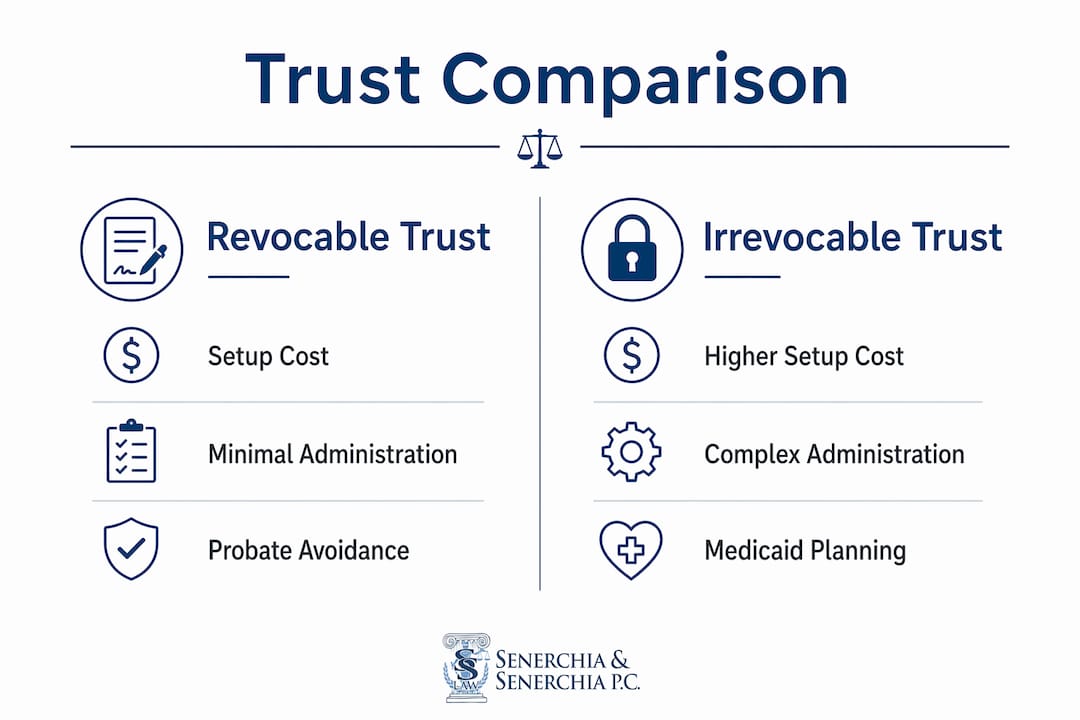
Cost is a practical reality that shapes which trust structure makes sense for your estate. Setting up a revocable living trust typically costs $2,000 to $5,000 in legal fees. Irrevocable trusts tend to cost more to establish because of their complexity, and professional trustee fees for irrevocable trusts run 0.5% to 1% annually of trust assets. On a $500,000 trust, that is $2,500 to $5,000 per year in ongoing fees.
The break-even point matters here. Trusts become more cost-effective than wills for estates exceeding roughly $100,000 to $200,000, depending on how complex your state’s probate process is. Rhode Island probate costs 0.2% to 0.5% of estate value in court fees alone, and the full process can take 6 to 24 months. For a $400,000 estate, that delay and expense adds up fast.
| Factor | Revocable trust | Irrevocable trust |
|---|---|---|
| Setup cost | $2,000–$5,000 | Higher, varies by complexity |
| Annual trustee fees | Minimal while grantor is alive | 0.5%–1% of trust assets |
| Probate avoidance | Yes, if fully funded | Yes, if fully funded |
| Best estate size | $100,000 and above | Larger estates or Medicaid planning |
| Ongoing administration | Low during grantor’s lifetime | Moderate to high |
| Asset protection | None | Strong |
Revocable trusts carry minimal ongoing administration while the grantor is alive. Most costs are front-loaded during setup and the funding process. Irrevocable trusts require more active management, separate tax filings, and trustee oversight year after year.
Pro Tip: Ask your attorney to estimate the total cost of probate for your specific estate before deciding between a will and a trust. For most Rhode Island families with a home and retirement accounts, a trust pays for itself within the first year of avoiding probate.
What should Rhode Island families consider when selecting trust options?
Selecting the right trust structure depends on your personal goals, not just your asset total. Rhode Island families face a specific set of considerations that make this decision more nuanced than a simple cost comparison.
Family structure and beneficiary needs shape everything. If you have minor children, a trust lets you control when and how they receive money. You can set conditions, such as reaching age 25 or completing college, before distributions are made. Families with a child who has special needs should consider a Special Needs Trust, which preserves the child’s eligibility for government benefits while still providing supplemental support.
Medicaid planning is one of the most urgent reasons Rhode Island families choose irrevocable trusts. When you transfer assets into an irrevocable trust for Medicaid purposes, a five-year look-back period applies. Any transfer made within five years of applying for Medicaid may trigger a penalty period. Early planning is not optional here. It is the only way to protect your home and savings from long-term care costs.
Tax planning adds another layer. As of 2026, the federal gift tax annual exclusion is $19,000 per recipient. A married couple can give up to $38,000 per recipient annually without reducing their lifetime federal gift tax exemption, which currently stands at $15 million. Funding an irrevocable trust using annual exclusion gifts is a proven strategy for reducing a taxable estate over time.
Additional considerations Rhode Island families should weigh:
- Asset titling: Every asset must be retitled into the trust’s name for the trust to work. A house still titled in your personal name passes through probate, even if your trust document exists.
- Blended families: Trusts let you protect children from a prior marriage while still providing for a current spouse.
- Business interests: If you own a business, an irrevocable trust can hold your ownership stake and protect it from personal liability.
- Real estate: Rhode Island families with multiple properties benefit most from trusts, since each property would otherwise require its own probate proceeding.
Trusts also enable control over wealth across generations by conditioning distributions. That kind of long-term control is not possible with a simple will.
How do trusts integrate with wills and other estate planning documents?
Trusts and wills are not competing documents. They work together, and most complete estate plans use both. A common misconception is that creating a trust makes a will unnecessary. That thinking leaves gaps that can cost your family time and money.
A pour-over will works alongside a revocable living trust to catch any assets you forgot to transfer into the trust during your lifetime. When you die, the pour-over will directs those stray assets into the trust, where they are then distributed according to your trust terms. The assets still go through probate, but they end up in the right place. Think of the pour-over will as a safety net beneath your trust.
A will is also the only document that can name a guardian for minor children. No trust can do that. If you have children under 18, a will is not optional. It is the legal mechanism that protects them if both parents die unexpectedly.
Beyond trusts and wills, a complete estate plan includes:
- Durable power of attorney: Names someone to manage your finances if you become incapacitated.
- Healthcare proxy: Names someone to make medical decisions on your behalf.
- Living will or advance directive: States your wishes for end-of-life medical care.
- Beneficiary designations: Retirement accounts and life insurance pass outside of both trusts and wills, so keeping these updated is critical.
Reviewing your estate plan every three to five years keeps it aligned with your life. Marriage, divorce, the birth of a child, or a significant change in assets all trigger the need for a review.
What are common pitfalls when setting up trusts for estate protection?
The most expensive mistake Rhode Island families make is creating a trust and never funding it. A trust only works if assets are retitled into the trust’s name. A trust document sitting in a drawer, with all your assets still titled in your personal name, provides zero probate protection. Your family will still face the full probate process.
Other common pitfalls include:
- Waiting too long for Medicaid planning: Transferring assets into an irrevocable trust the year before you need nursing home care triggers the five-year look-back penalty. The time to act is years in advance, not during a health crisis.
- Choosing the wrong trustee: A trustee has legal duties to manage and distribute assets responsibly. Choosing a family member who lacks financial discipline or who has conflicts with other beneficiaries creates problems. Consider a professional trustee or a corporate trustee for larger or more complex trusts.
- Ignoring beneficiary designations: Retirement accounts and life insurance pass directly to named beneficiaries, bypassing your trust entirely. An outdated beneficiary designation can undo years of careful planning.
- Failing to update documents: A trust drafted when your children were minors may not reflect your wishes now that they are adults with their own families.
“The best estate plan is one that gets reviewed, not just created. A trust is a living document that should grow with your family.”
Pro Tip: After signing your trust documents, schedule a funding meeting with your attorney to retitle your home, bank accounts, and investment accounts. Do not leave the office without a clear checklist of every asset that needs to be transferred.
Senerchia & Senerchia Law helps Rhode Island families plan with confidence
Choosing between trust structures is one of the most consequential decisions your family will make. Senerchia & Senerchia Law guides Rhode Island families through every step, from selecting the right trust type to funding it correctly and integrating it with wills, powers of attorney, and healthcare directives. The firm’s attorneys take time to understand your goals, your family, and your assets before recommending a path forward. Whether you are setting up your first living trust in Rhode Island or revisiting an existing plan, Senerchia & Senerchia Law provides the personalized guidance you need. You can also review the estate planning documents the firm prepares for families to understand exactly what a complete plan includes.
Key takeaways
Matching your trust type to your specific estate protection goals is the foundation of every sound estate plan in Rhode Island.
| Point | Details |
|---|---|
| Revocable vs. irrevocable | Revocable trusts offer control and flexibility; irrevocable trusts provide asset protection and tax benefits. |
| Probate avoidance | Both trust types avoid probate only when fully funded with assets retitled into the trust’s name. |
| Medicaid timing | Transfers into irrevocable trusts trigger a five-year look-back period, making early planning critical. |
| Cost break-even | Trusts become more cost-effective than wills for estates above $100,000 to $200,000. |
| Integrated planning | A complete estate plan combines a trust, a pour-over will, a power of attorney, and a healthcare proxy. |
FAQ
What is the main difference between a revocable and irrevocable trust?
A revocable trust lets you keep control of your assets and change the trust at any time, but it offers no creditor or Medicaid protection. An irrevocable trust removes assets from your legal ownership, which provides strong protection but eliminates your ability to amend the terms.
Does a trust replace a will in Rhode Island?
A trust does not replace a will. Most Rhode Island estate plans use both. A pour-over will captures any assets not transferred into the trust, and a will is the only document that can name a guardian for minor children.
How much does it cost to set up a trust in Rhode Island?
A revocable living trust typically costs $2,000 to $5,000 in legal fees to establish. Irrevocable trusts vary in cost depending on complexity, and professional trustee fees generally run 0.5% to 1% of trust assets annually.
When should I start Medicaid planning with an irrevocable trust?
Start as early as possible. Transfers into an irrevocable trust are subject to a five-year look-back period for Medicaid eligibility. Planning during a health crisis is often too late to protect your home or savings.
What happens if I create a trust but never fund it?
An unfunded trust provides no protection. Assets still titled in your personal name will pass through probate, regardless of what your trust document says. Retitling assets into the trust’s name is the step that makes the trust effective.