


A complete family estate plan is a coordinated portfolio of legal documents designed to protect your assets during life, manage your affairs during incapacity, and distribute your wealth to the people you love after you are gone. Most families think a will is enough. It is not. A complete estate plan includes a revocable living trust, a last will and testament, a durable power of attorney, an advance healthcare directive, and a HIPAA authorization. Each document serves a distinct purpose, and together they form a system that protects your family at every stage. When you build a complete family estate plan, you are not just signing papers. You are making decisions that will shape your family’s future for generations.
What documents and roles make up a complete family estate plan?
A complete estate plan is a coordinated portfolio that covers asset transfer after death and decision-making during incapacity. Understanding what each document does, and who carries out each role, is the foundation of everything else.
Here are the five core documents every family estate plan should include:
- Revocable living trust. Think of a trust as a container that holds your assets. You create it, you control it during your lifetime, and you name a successor trustee to manage it if you become incapacitated or die. A fully funded trust avoids probate for any asset placed inside it and keeps your family’s financial affairs private.
- Last will and testament. A will is your backup document. It covers any assets that did not make it into your trust, names a guardian for minor children, and appoints an executor to manage your estate through probate if needed. Without a will, a court decides who raises your children.
- Durable power of attorney. This document gives a trusted person, called your agent, the legal authority to manage your finances if you cannot. It covers everything from paying bills to managing investments.
- Advance healthcare directive. Also called a living will or healthcare proxy, this document tells your doctors and family what medical treatment you want if you cannot speak for yourself. It removes an enormous burden from your loved ones during an already painful time.
- HIPAA authorization. This is the document most families overlook. Without it, your fiduciaries cannot legally access your medical records, which directly limits their ability to make informed healthcare decisions on your behalf.
Pro Tip: Name a primary and a backup person for every role. Life changes, and your first choice may not be available when the time comes.
Beyond the documents, you need to assign four key roles: executor (administers your will), trustee (manages your trust), guardian (cares for minor children), and agent (handles finances and healthcare decisions). Choosing fiduciaries requires assessing willingness, capability, and potential conflicts. Many families choose someone out of love rather than competence, which creates problems later.

| Document | Primary purpose | Avoids probate? |
|---|---|---|
| Revocable living trust | Asset management and distribution | Yes, for funded assets |
| Last will and testament | Guardian naming, backup asset distribution | No |
| Durable power of attorney | Financial decisions during incapacity | Not applicable |
| Advance healthcare directive | Medical decision-making authority | Not applicable |
| HIPAA authorization | Medical records access for fiduciaries | Not applicable |
How to build your family estate plan step by step
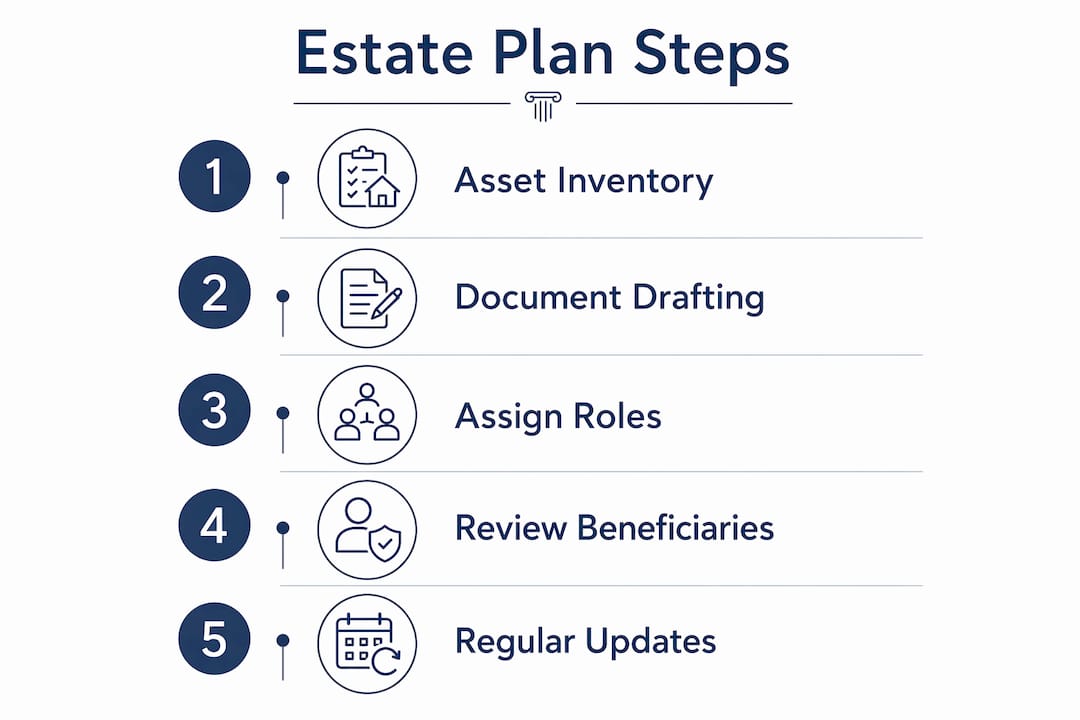
Building your estate plan is a process, not a single event. Follow these steps in order, and you will have a coordinated plan that actually works when your family needs it most.
- List all assets and liabilities. Start with a complete inventory: real estate, bank accounts, retirement accounts, life insurance policies, business interests, vehicles, and personal property. Include debts as well. You cannot plan what you have not mapped.
- Define your goals and legacy intentions. Ask yourself who you want to receive your assets, at what age, and under what conditions. Do you want to support a charity? Protect a child with special needs? Prevent a beneficiary from receiving a lump sum they are not ready to manage? Your answers shape every document you draft.
- Choose your fiduciaries carefully. Have direct conversations with the people you are considering. Make sure they understand the responsibilities involved and are genuinely willing to serve. Clear role assignments reduce misunderstandings and conflict during estate execution.
- Draft your documents with professional guidance. Work with an estate planning attorney to prepare your trust, will, power of attorney, healthcare directive, and HIPAA authorization. Each document must be properly executed under your state’s laws to be valid.
- Update your beneficiary designations. Retirement accounts like IRAs and 401(k)s, life insurance policies, and payable-on-death bank accounts pass directly to named beneficiaries. Beneficiary designations override wills and trusts for these asset types, which means a misaligned designation can send money to the wrong person entirely.
- Organize and store your documents securely. Keep originals in a fireproof safe or with your attorney. Share the location and copies with your fiduciaries. Organized, accessible documents prevent delays and confusion when your family is already under stress.
- Schedule regular reviews. Your plan is a living document. Set a reminder to review it every three to five years, and immediately after any major life event.
Pro Tip: Create a simple one-page “estate plan summary” that lists your key documents, where they are stored, and who holds each role. Give a copy to your executor and successor trustee.
| Step | What to do | Why it matters |
|---|---|---|
| Asset inventory | List all property, accounts, and debts | Prevents assets from being missed |
| Goal setting | Define distribution wishes and conditions | Shapes every document you draft |
| Fiduciary selection | Confirm willingness and capability | Reduces conflict during execution |
| Document drafting | Work with an attorney for valid execution | Legally protects your intentions |
| Beneficiary review | Align designations with your plan | Prevents assets going to wrong recipients |
How do trusts and wills work together?
Trusts and wills are not competing documents. They are partners, and understanding how they complement each other helps you decide what your family actually needs.
A revocable living trust is the workhorse of most modern estate plans. Assets placed inside the trust pass directly to your beneficiaries without going through probate, the court-supervised process that validates a will and authorizes asset distribution. Probate costs vary by state and can reach 2% to 7% of the gross estate. On a $500,000 estate, that is $10,000 to $35,000 in fees and delays. A funded trust eliminates that cost for the assets it holds.
A will, by contrast, covers everything that did not make it into the trust. It also does two things a trust cannot: name a guardian for your minor children and formally appoint your executor. Every family with a trust still needs a will, typically called a “pour-over will,” which directs any stray assets into the trust at death.
Here is a practical way to think about when each tool is most useful:
- Simple will only: Appropriate for young adults with minimal assets, no children, and straightforward wishes. Fast and inexpensive to create, but assets will go through probate.
- Revocable living trust plus pour-over will: The right choice for most families with real estate, minor children, blended family situations, or a desire for privacy and probate avoidance.
- Beneficiary designations as a complement: Retirement accounts and life insurance policies should name beneficiaries directly. These designations work alongside your trust and will but operate independently of both.
One common misconception is that a trust eliminates all taxes. It does not. A revocable living trust is transparent for income tax purposes during your lifetime. Tax planning requires additional strategies, often coordinated with your financial advisor and attorney together.
Common estate planning mistakes and how to avoid them
Even families with good intentions make costly errors. Recognizing these mistakes before they happen saves your loved ones time, money, and conflict.
- Relying solely on a will. A will alone means probate, which is public, slow, and expensive. Anyone can look up what you owned and who received it. A trust keeps those details private.
- Failing to fund the trust. Creating a trust without transferring assets into it is one of the most common and damaging mistakes in family estate planning. An unfunded trust provides none of the benefits it was designed to deliver. Your home, bank accounts, and investment accounts must be retitled in the name of the trust.
- Neglecting to update the plan. Estate plans require regular review as life events and laws change. A birth, death, marriage, or divorce can completely misalign your existing documents. The beneficiary you named ten years ago may no longer be the right choice.
- Choosing unprepared fiduciaries. Naming your oldest child as executor out of tradition, without confirming they understand the role, creates real problems. Fiduciaries must understand their responsibilities clearly to avoid administrative errors and family conflict.
- Ignoring beneficiary designation coordination. Retirement accounts and life insurance policies pass outside of your will and trust. A beneficiary designation that contradicts your estate plan can send assets to an ex-spouse or a minor child who legally cannot receive them.
- Keeping the plan a secret. Not involving your family in basic discussions leads to surprises and disputes. You do not need to share every detail, but your fiduciaries should know they have been named and understand what is expected of them.
Pro Tip: Review your beneficiary designations every time you review your estate plan. Treat them as part of the same document, because legally they function that way.
For a deeper look at pitfalls that catch families off guard, the common estate planning mistakes resource from Sslawne covers real scenarios worth reading before you finalize your plan.
How to maintain and update your family estate plan over time
An estate plan is not a one-time project. It is an ongoing commitment to your family’s security, and it requires attention as your life evolves.
- Set a review schedule. Commit to reviewing your plan every three to five years at minimum. Put it on your calendar the same way you schedule a medical checkup.
- Review after every major life event. Marriage, divorce, the birth of a child, the death of a beneficiary or fiduciary, a significant change in assets, or a move to a new state all require a plan review. Laws differ by state, and what was valid in one jurisdiction may need adjustment in another.
- Keep your family informed. Facilitating family conversations about mortality and legacy is as important as the legal drafting itself. Your executor and trustee should know where documents are stored, what their roles involve, and who to contact for guidance.
- Coordinate with your financial advisor. Your estate plan and your financial plan should speak the same language. A unified family balance sheet perspective improves coordination across accounts, beneficiary designations, and tax strategies.
- Update documents and designations together. When you amend your trust or will, review your beneficiary designations at the same time. These two pieces must stay aligned to prevent unintended outcomes.
The families who handle estate administration most smoothly are the ones who treated the plan as a living document, not a filing cabinet item. Regular updates and open communication are what separate a plan that protects your family from one that creates confusion.
Key takeaways
A complete family estate plan requires five coordinated documents, carefully chosen fiduciaries, aligned beneficiary designations, and regular updates to remain effective over time.
| Point | Details |
|---|---|
| Five core documents | Trust, will, power of attorney, healthcare directive, and HIPAA authorization work together as a system. |
| Fund your trust | Assets must be retitled into the trust or it provides no probate avoidance benefit. |
| Align beneficiary designations | Retirement accounts and life insurance override your will, so designations must match your plan. |
| Choose fiduciaries deliberately | Confirm willingness and capability before naming anyone as executor, trustee, or agent. |
| Review regularly | Update your plan after every major life event and at least every three to five years. |
Why estate planning is really about your family, not your documents
After years of working with families through this process, the clearest lesson I have learned is this: the legal documents are the easy part. The harder work is the conversations that have to happen before, during, and after those documents are signed.
Families that communicate openly about their wishes, their reasoning, and their expectations for fiduciaries experience far less conflict when a plan is eventually executed. Families that keep everything secret, even with the best intentions, often leave behind confusion and resentment alongside their assets. I have seen a beautifully drafted trust create family conflict simply because no one had told the successor trustee what the role actually required.
The other thing I would push back on is the idea that estate planning is a one-time event you complete and forget. The families I have seen navigate estate administration most gracefully are the ones who treated their plan like a relationship, something they returned to, updated, and talked about over time. That ongoing attention is what makes the difference between a plan that protects your family and one that merely existed on paper.
— Rich
Work with an estate planning attorney who knows your family
Estate planning is personal, and the stakes are too high for a generic approach. At Sslawne, Senerchia & Senerchia P.C. works directly with Rhode Island families to build plans that reflect their real goals, not just their asset list. From drafting revocable living trusts and wills to coordinating beneficiary designations and powers of attorney, the team provides the kind of attentive, personalized guidance that makes a complex process feel manageable. If you are ready to protect your family’s future, start with a risk-free 15-minute discovery call. Explore your options with the estate planning attorneys at Sslawne and take the first step toward a plan your family can count on.
FAQ
What is included in a complete family estate plan?
A complete family estate plan includes a revocable living trust, last will and testament, durable power of attorney, advance healthcare directive, and HIPAA authorization. Together, these documents cover asset distribution, financial management during incapacity, and medical decision-making authority.
Do I need both a trust and a will?
Yes. A trust manages and distributes assets placed inside it while avoiding probate, but a will is still necessary to name guardians for minor children and catch any assets that were not transferred into the trust.
How often should I update my estate plan?
Review your estate plan every three to five years and immediately after any major life event such as a marriage, divorce, birth, death, or significant change in assets or state of residence.
What happens if I never update my beneficiary designations?
Beneficiary designations on retirement accounts and life insurance policies override your will and trust. An outdated designation can send assets to an ex-spouse, a deceased person, or a minor child who cannot legally receive them, regardless of what your other documents say.
How do I choose the right executor or trustee?
Choose someone who is organized, trustworthy, and genuinely willing to serve. Have a direct conversation with them before naming them, confirm they understand the responsibilities, and always name a backup in case your first choice is unavailable.